
Democracy with the Doors Wide Open
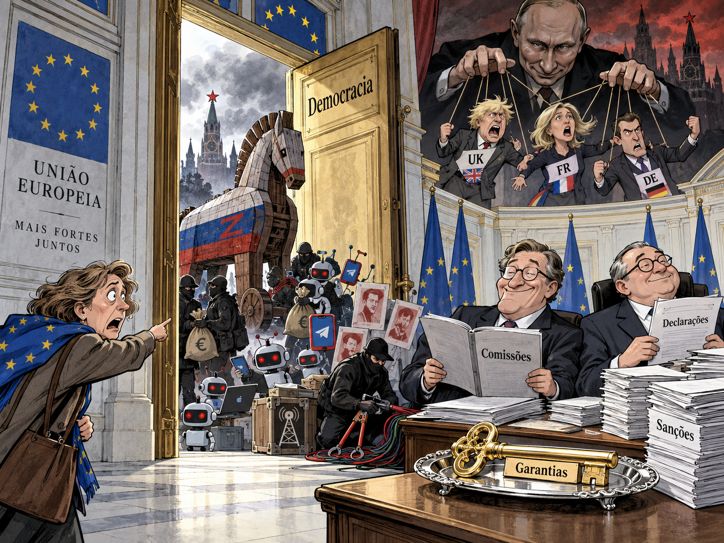
Democracy with the Doors Wide Open
When democratic safeguards become a strategic vulnerability
There is something profoundly disturbing about the way Europe has learned to defend democracy.
We created constitutions, independent courts, procedural safeguards, fundamental rights, freedom of expression, political pluralism, protection of minorities, the presumption of innocence and dozens of mechanisms designed to prevent power from crushing the individual.
It was an extraordinary civilisational achievement.
The problem begins when we confuse civilisation with naivety.
A democracy that offers safeguards to its citizens must defend them fiercely. But a democracy that allows those very safeguards to be used by foreign powers to infiltrate, manipulate and weaken the system begins to look less like a free society and more like a house whose owner has installed excellent locks on every interior door while leaving the front door wide open.
With the key still in the lock.
And a small sign beside it:
Vladimir Putin does not respect those rules.
He never said he would.
He never built a regime based on them.
He has never shown any reluctance to use espionage, disinformation, sabotage, energy blackmail, cyberattacks, indirect financing, political intermediaries and influence operations to advance Russia's strategic interests.
And yet, for far too long, Europe responded with the bureaucratic solemnity of someone who discovers a fire in the building and decides to appoint a committee to study the temperature of the flames.
Meetings.
Statements.
Resolutions.
Condemnations.
Sanctions.
More meetings.
More statements.
And in the meantime, the adversary kept working.
Not merely at Europe's borders.
Inside Europe.
The war has already come through the side door
This is the real dimension of hybrid warfare that many European leaders still seem reluctant to confront fully.
The battlefield no longer begins when a tank crosses a border.
It begins in a bank account.
On a server.
In a Telegram group.
Inside a shell company.
Within an apparently harmless association.
In a source of funding whose origin nobody examines too closely.
In a politician who returns from Moscow suddenly persuaded that every Russian strategic position is perfectly reasonable.
In a former government official who unexpectedly discovers remarkable professional virtues in a company tied to Russian energy interests.
In a political movement whose message happens to coincide, point by point, with what benefits the Kremlin.
Individually, none of these situations necessarily proves a crime.
But this is precisely what intelligence services are supposed to do:
Not afterwards.
The syndrome of infinite safeguards
This is where Europe appears to have developed a peculiar institutional illness.
Let us call it the syndrome of infinite safeguards.
Whenever an internal threat appears, the immediate fear is that democratic rights might somehow be touched.
Political freedom must be respected.
Correct.
The presumption of innocence must be respected.
Obviously.
The opposition must be protected.
Without question.
Political persecution must be prevented.
Absolutely.
But none of this means that a state must close its eyes when there are indications of clandestine foreign funding, suspicious contacts, influence networks or collaboration with a hostile power.
Investigating is not convicting.
Judicially authorised surveillance is not persecution.
Following financial flows is not abolishing democracy.
Examining contacts with foreign intelligence services is not establishing a dictatorship.
It is precisely what a responsible state should do.
Because there is an enormous difference between disagreeing with European foreign policy and secretly working for the strategic interests of another state.
The first is democracy.
The second may constitute a crime against sovereignty or national security when the facts and the applicable law establish it.
Treason has changed its clothes
And perhaps this is precisely the word Europe has become afraid to pronounce.
Treason.
It exists in criminal codes.
It exists in constitutions.
It exists in the legal concepts surrounding national sovereignty.
Yet it seems to have been turned into a linguistic relic, reserved for ancient wars in which enemies wore uniforms and carried easily identifiable flags.
The modern traitor may not carry secret documents in a briefcase.
He may carry a narrative.
He may not receive direct orders from an intelligence service.
He may receive money through three intermediaries.
He may never advocate the military invasion of his own country.
He may simply work, decision after decision, to weaken the alliances that protect it.
It is a much more sophisticated form of aggression.
And much harder to combat.
But difficulty cannot become an excuse.
No free society is morally obliged to facilitate its own destruction.
A democracy has the right to defend itself.
More than that.
It has the duty to do so.
Not against opinions.
Not against dissidents.
Not against citizens who think differently.
But against organisations, individuals or networks which, once evidence exists and under judicial oversight, are shown to work clandestinely for the interests of a hostile foreign power.
That distinction should be written in enormous letters at the entrance to every European institution.
Freedom to think anything.
Freedom to criticise anything.
Freedom to propose a different foreign policy.
But no special freedom to receive secret money, instructions or benefits from those who seek to weaken European sovereignty.
That is not pluralism.
It is strategic penetration.
The cheapest weapon
There is a reason Russia prefers this form of confrontation.
It is extraordinarily cheap.
A military division costs billions.
An influence campaign may cost a tiny fraction of that.
A missile can destroy a building.
A well-executed political operation can change a government.
A tank can occupy a road.
An influenced politician can change a law.
Which weapon is more powerful?
Russian strategists did that calculation long ago.
Europe still seems to be discussing whether the calculator has received the proper regulatory certification.
The ballot box may remain perfectly intact
Then there is the electoral problem.
It is perfectly possible to imagine that, in the not-too-distant future, a major European democracy might democratically elect a leader whose policies are profoundly favourable to Moscow's strategic interests.
No election needs to be physically rigged.
No ballot boxes need to be replaced.
No millions of votes need to be directly falsified.
It is enough to influence the political environment for years.
Amplify genuine grievances.
Exploit real economic crises.
Turn immigration problems into permanent fury.
Increase distrust in institutions.
Promote conspiracy theories.
Finance selected media ecosystems.
Favour certain candidates.
Destroy reputations.
Multiply false content.
And then allow citizens to vote freely.
The ballot box remains democratic.
The environment that led people to it may no longer be.
That is the perverse brilliance of hybrid warfare.
And perhaps one day Europe will wake up with a government willing to abandon Ukraine, dismantle sanctions, weaken NATO, block European security decisions and restore privileged relations with Moscow.
All constitutional.
All approved.
All perfectly legal.
And then, inevitably, a new parliamentary committee will be created.
They will ask:
As always.
Because all the warning signs were there.
What was missing was the courage to call them by their name.
Defence is not repression
Democracies must therefore abandon the childish idea that their moral purity depends on their inability to defend themselves.
A mature democracy should not fear investigating political networks when objective indications of foreign interference exist.
It should do so.
With judicial authorisation.
With parliamentary oversight.
With clear legal limits.
With later transparency whenever possible.
But it should do so.
Bank accounts.
Companies.
Foundations.
Cryptocurrencies.
Travel.
Intermediaries.
Communications.
Contacts with foreign representatives.
Economic benefits.
Business relationships.
Anything capable of revealing clandestine dependence on an external power should be open to investigation when sufficient grounds exist.
It should not matter whether the suspect belongs to the far right.
The far left.
The centre.
A historic mainstream party.
A small populist movement.
Or to that respectable European club of former ministers who, after leaving government, suddenly develop a mysterious professional passion for large foreign corporations.
Counter-intelligence should not ask:
"Which party does this person belong to?"
It should ask:
That is the question that matters.
Twenty-seven pieces, one adversary
And this is where Brussels needs to wake up.
The European Union built a common currency.
A common market.
Partially common borders.
Common trade policies.
Common regulation.
Common sanctions.
But it still lacks a genuine counter-intelligence architecture proportionate to the political scale of the threat it faces.
There are excellent national intelligence services.
What is missing is an integrated European capacity to connect information from different countries quickly enough.
An intermediary may live in Prague.
The company may be registered in Cyprus.
The money may pass through Vienna.
The beneficiary may operate in Paris.
The server may be in Amsterdam.
And the operation may be directed from Moscow.
Each state sees one piece.
The adversary sees the whole board.
And as long as Europe remains organised administratively while its adversary is organised strategically, the advantage will remain on the wrong side.
WHAT SHOULD BE REMEMBERED
- The EU itself recognises persistent hybrid campaigns involving sabotage, cyberattacks, electoral interference and information manipulation.
- Investigating foreign financing, contacts and influence networks is not the same thing as criminalising political opinions.
- Protecting democracy requires both strong judicial safeguards and effective preventive counter-intelligence.
- Fragmentation between Member States favours transnational operations designed to exploit different jurisdictions.
- Electoral security begins long before election day.
Freedom needs security
This is not an argument for repression.
It is precisely an argument for freedom.
There is something profoundly absurd about believing that protecting democratic rights requires us to provide the tools needed by those who wish to destroy them.
Democratic tolerance cannot mean tolerance of foreign subversion.
The presumption of innocence does not create an obligation to remain blind.
Freedom of expression is not immunity from criminal investigation.
Pluralism does not turn clandestine financing into an opinion.
And sovereignty cannot be merely a beautiful word spoken at official ceremonies.
It must have consequences.
Europe finally needs to learn something that any minimally competent computer system learned decades ago:
A computer network does not allow every user to execute every instruction merely because it believes in freedom of use.
It authenticates.
It logs.
It monitors.
It separates privileges.
It detects anomalous behaviour.
It blocks attacks.
It investigates intrusions.
And it remains perfectly functional.
Perhaps it is time to apply to democracy a little of the intelligence we already apply to servers.
Because at this moment there is something almost tragic about Europe.
We built one of the freest societies in human history.
And precisely because of that, some of its leaders seem terrified by the possibility of defending it firmly.
Putin does not have that problem.
Authoritarian regimes understand our vulnerabilities perfectly well.
They study them.
They exploit them.
They finance them.
And they wait.
They have time.
The question is whether we do.
The danger of arriving correctly, but too late
Because perhaps one day we will finally discover that we are ready to defend democracy.
We will have new laws.
New services.
New financial mechanisms.
New counter-intelligence instruments.
New European protocols.
Everything carefully approved.
Everything legally impeccable.
Everything democratically supervised.
There will be only one small problem:
And at that moment perhaps someone will look back and ask how it was possible for a civilisation so educated, so regulated, so legally sophisticated and so proud of its values to hand the adversary the key to its own front door.
The answer will be embarrassingly simple:
because it confused freedom with the absence of defence.
And while we debated one more safeguard, one more guarantee and one more institutional precaution, someone on the other side was already trying the key.
Europe, wake up
Do not abandon your rights.
Do not abandon your safeguards.
Do not abandon the rule of law.
But, for democracy's own sake, abandon your naivety.
Because a democracy that does not know how to defend itself may continue to have elections, parliaments and constitutions.
It may simply no longer possess genuine sovereignty.
And when it finally understands the difference, it may discover that the door is still open.
But it is no longer the one holding the key.
Editorial Note
Credible International References
- Council of the European Union — Council adopts conclusions on advancing the EU's capacity to counter hybrid threats
- European External Action Service — Countering Hybrid Threats
- Council of the European Union — Russian hybrid threats: four individuals added to EU sanctions list for information manipulation activities
- European Parliament — Russiagate: allegations of Russian interference in the democratic processes of the European Union
- VIGINUM / SGDSN — Protection of public debate against foreign digital interference during the March 2026 municipal elections
- VIGINUM / SGDSN — The state of the information threat
- GOV.UK — The Rycroft Review: countering foreign financial influence and interference in UK politics
- Federal Government of Germany — Intelligence services legislation to be reformed
- Reuters — Russia divide resurfaces as AfD leads in Saxony-Anhalt
- Reuters — Russia recruits Danes for sabotage planning, Denmark says