
Portugal: An Infantile and Tribal Democracy
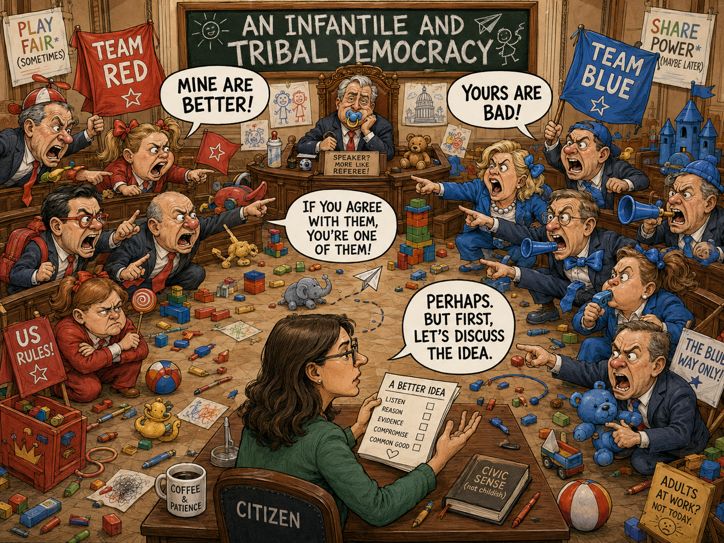
An Infantile and Tribal Democracy
When the party shirt matters more than the argument, democracy may continue to vote — but it begins to forget how to think.
Opening Note:
Democracy does not mean that we all agree. It is precisely the system that allows us to disagree without turning an opponent into an enemy and without requiring an idea to present its party membership card before being allowed into the discussion.
There are adult democracies.
And then there are democracies that, despite having a Constitution, a Parliament, elections, universities, commentators, experts and millions of citizens with degrees, still discuss politics like children in a school playground.
"He started it."
"Mine are better."
"Yours are bad."
"If you agree with them, then you must be one of them."
And so we continue, with great solemnity, calling this public debate.
An idea is no longer just an idea
In an intellectually healthy democracy, a proposal should be judged by what it contains.
Is it useful?
Is it feasible?
Are the costs acceptable?
Does it solve the problem?
Is there evidence?
Are there better alternatives?
But tribal democracy works differently.
First we ask:
Who said it?
Then:
Which party are they from?
Then:
Are they one of us or one of them?
And only after that, if there is still any energy left, someone may actually read the proposal.
Content has become almost secondary.
Origin increasingly determines value.
A good idea may be rejected simply because it came from the wrong side of the chamber.
A bad idea may be defended enthusiastically simply because it came from the right mouth.
It is quality control turned upside down.
If you agree, you belong
Perhaps one of the most childish symptoms of this culture is the inability to separate agreement from belonging.
If someone says:
"I agree with this proposal from that party."
the natural response should be:
"Why?"
But the social response is often:
"So you are one of them now?"
Fascinating.
As if recognising merit in an idea automatically required filling in a party membership form.
Agreeing with a liberal proposal does not make someone a liberal.
Agreeing with a socialist measure does not make someone a socialist.
Recognising that a conservative has correctly identified a problem does not oblige anyone to purchase the entire ideological package.
Ideas do not transmit ideology by physical contact.
Political virology has not yet advanced that far.
The infallible party
There is something that should worry any minimally rational person.
Someone who, across dozens of completely different subjects, always concludes that their party is right.
The economy?
Right.
Healthcare?
Right.
Education?
Right again.
Energy?
Naturally.
Immigration?
How could it possibly be otherwise?
Tax policy, housing, justice, science, transport, agriculture, defence?
Miracle of miracles: the party always has the correct answer.
There are two possibilities.
Either we have finally discovered the first infallible human organisation in history.
Or that person is no longer evaluating ideas.
They are defending an identity.
The second possibility seems slightly more plausible.
Politics turned into football
Tribal logic brings politics dangerously close to football.
There is a team.
There are shirts.
There are opponents.
There are victories.
There are defeats.
And, above all, there is loyalty.
If the referee decides in our favour, justice has been done.
If the decision goes against us, it is a scandal.
Politics often works in much the same way.
If an economic measure produced by our side gives poor results:
"It is complex."
"It needs time."
"There were external factors."
If the same thing happens to the other side:
"It failed."
"It was predictable."
"Resign."
The analysis did not change.
Only the shirt did.
And perhaps that is why so many political arguments seem incapable of producing any synthesis.
No one entered the room to learn.
They entered to win.
Parliament as an organised playground
Political parties themselves often feed this infantilisation.
A responsible opposition should be able to say:
"This government measure is good and we will support it."
And an adult government should be able to reply:
"The opposition has presented a better proposal than ours. We will integrate it."
That would be extraordinarily healthy.
Perhaps even disturbing.
But political competition contains less noble incentives.
If we support the opponent's proposal, the opponent may receive the credit.
If we admit they were right, we may look weak.
So the proposal is rejected.
Even when it is useful.
Democracy wastes intelligence simply because it came from the wrong side of the chamber.
That is a particularly absurd luxury in a small country.
The fear of dissonance
A tribal society does not particularly like intellectually independent people.
They are difficult to classify.
Today they agree with a proposal from the left.
Tomorrow they defend a liberal solution.
Then they criticise both.
Later they acknowledge merit in a conservative argument.
This is intolerable to the tribal mind.
"So whose side are you actually on?"
The correct answer should be:
On the side of the best available idea for this particular problem.
But that answer causes anxiety.
Because it requires thinking issue by issue.
And thinking issue by issue is far more demanding than choosing a flag and receiving opinions as a complete subscription package.
Democracy as a complete ideological bundle
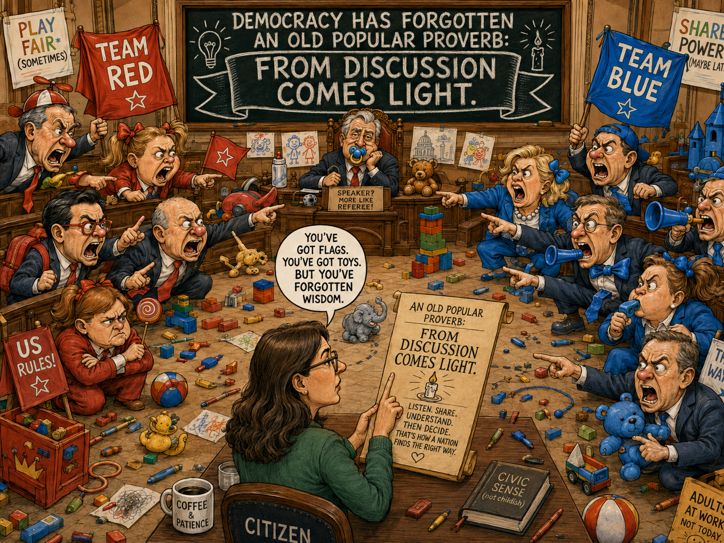
Political parties often operate like ideological subscription services.
Once subscribed, you receive:
an economic position;
a social position;
an environmental position;
a cultural position;
a view on immigration;
a view on defence;
a view on education;
and, eventually, opinions on events that have not even happened yet.
Efficient.
It saves a considerable amount of brainpower.
The problem is that reality was not designed by ideological departments.
A person can simultaneously defend a strong social state, competitive markets, fiscal discipline, individual freedom, strategic public investment and less bureaucracy.
There is no law of nature requiring these ideas to live apart.
But tribal logic prefers boxes.
Boxes are easier to organise.
Independent minds ruin the filing system.
Disagreement has become aggression
In a mature democracy, disagreement is raw material.
It is how an idea is tested.
Someone proposes something.
Another person criticises it.
A third introduces data.
The first recognises an error.
The proposal is revised.
A better solution eventually emerges.
It sounds almost like science fiction.
Today, far too often, disagreement means attack.
If we question an idea, we are said to be attacking the person.
If we criticise a policy, we supposedly hate the group.
If we ask for evidence, we are being hostile.
And once criticism is interpreted as aggression, debate dies quickly.
What remains is internal applause and external insult.
Democracy needs heretics
Every society needs people willing to commit small acts of intellectual heresy.
To say:
"My side is wrong."
"The others are right on this point."
"I used to believe this, but I changed my mind."
"I do not know."
"I need to understand this better."
These should be signs of intellectual strength.
In a tribal culture they can be treated as betrayal.
The problem is ancient.
Human groups have always valued loyalty.
The brain likes belonging.
Belonging offers security.
But democracy demands something harder.
It demands the ability to belong without surrendering one's conscience.
The price of thinking
Thinking freely has social costs.
We may disappoint our group.
We may lose approval.
We may temporarily find ourselves without a tribe.
That is why following is so easy.
The tribe offers answers.
Doubt offers work.
But societies that stop tolerating doubt become intellectually rigid.
And rigid systems adapt badly.
That applies to companies.
To institutions.
To countries.
Democratic poverty
A democracy can hold perfectly free elections and remain intellectually poor.
It can have televised debates and no real discussion.
It can have hundreds of commentators and very little reflection.
It can have universities and still cultivate conformity.
It can have freedom of expression and use it almost exclusively to repeat what each group already believes.
Formally, everything works.
But what gives democracy vitality is missing:
the circulation of ideas across boundaries.
When a good proposal can cross party lines.
When criticism from an opponent is heard.
When someone can change their mind without being treated as a deserter.
That is when democracy is alive.
We do not need to agree
There is another curious misunderstanding.
Democracy does not exist to produce permanent consensus.
It exists precisely to allow disagreement without violence.
We do not all have to think alike.
It would be terrifying if we did.
Diversity of perspective is an advantage.
An engineer sees a problem one way.
A doctor another.
An economist another.
A worker another.
An entrepreneur another.
A young person another.
A pensioner another.
Knowledge can emerge from that friction.
But only if we are willing to listen before classifying.
The adult society
Perhaps democratic maturity can be measured by a simple sentence:
"I do not like the politics of the person who said this, but on this issue they are right."
It seems small.
It is enormous.
Because at that moment truth became more important than belonging.
The idea separated itself from the author.
The citizen stopped being a supporter and became a citizen again.
And that is precisely what an adult democracy requires.
Not people without convictions.
But people whose convictions are not prisons.
Not citizens who are indifferent to parties.
But citizens capable of saying no to them.
Not a society without ideologies.
But a society in which no ideology owns the rights to reason.
Leaving the playground
Portugal does not merely need better policies.
It needs a more adult political culture.
A culture in which a proposal can be discussed without first checking the party membership of the person who presented it.
Where changing one's mind is not shameful.
Where disagreement is not insult.
Where recognising merit in an opponent is not desertion.
Where parties can cooperate without appearing to have lost.
And where a citizen can think one thing today and another tomorrow because, in the meantime, they encountered better arguments.
Democracy is not the art of proving that our tribe is always right.
It is the far more difficult art of building collective decisions among people who will never completely agree.
When we forget that, we are left only with flags.
With slogans.
With applause.
With parliamentary trench warfare.
And with an infantile version of politics in which everyone shouts:
"Mine are better."
An adult democracy begins at exactly the moment when someone is able to reply:
"Perhaps. But first, let us discuss the idea."
KEY POINTS
- Party identification can operate as a cognitive shortcut and can shift citizens' evaluations of political positions, although average effects are often modest.
- Affective polarisation refers to emotional distance and dislike between supporters of rival political camps, not merely disagreement over policy.
- In Portugal, research covering 2002–2024 finds moderate and relatively stable affective polarisation, but a growing association with electoral participation and left–right voting choices.
- Appeals involving social groups can change support for policies depending on citizens' prior attitudes towards those groups.
- Affective polarisation may increase political participation, while also raising concerns about social cohesion, compromise and democratic quality.
- A healthy democracy depends not on the absence of disagreement, but on the ability to evaluate arguments, negotiate and live with legitimate dissent.
Editorial Note
This chronicle is an opinion piece and deliberately uses humour, caricature and expressions such as "infantile democracy" and "tribe" to describe mechanisms of political identity. It does not claim that all Portuguese citizens, party members or political parties systematically judge ideas only by their source.
Political science nevertheless offers concepts that help explain the phenomenon. One is party cueing: partisan signals can operate as cognitive shortcuts through which citizens infer whether they should support or reject a given position. Recent research in the American Journal of Political Science, using real news content, found that party cues modestly increased support for positions associated with a reader's own party. The average effect was small, but statistically detectable.
Another relevant concept is affective polarisation, usually understood as emotional distance or dislike between supporters of rival political camps. A study on Portugal based on the Portuguese Election Studies from 2002 to 2024 concluded that Portuguese levels remained moderate and relatively stable during the period. The same study nevertheless found a growing association between affective polarisation and electoral participation, as well as a stronger relationship with choices between parties of the left and right.
Social identity can also interfere with the evaluation of policy. Research published in The Journal of Politics experimentally showed that positive or negative references to social groups can move support for proposals depending on citizens' prior attitudes towards the groups involved. A policy can therefore be judged not only by its substantive characteristics, but also through the affective filter attached to those presented as its beneficiaries, opponents or symbolic references.
The literature does not support a simplistic conclusion that all partisanship necessarily damages democracy. Political parties help citizens organise political information, coordinate interests and make electoral competition possible. Research has also found circumstances in which party cues can moderate extreme positions rather than simply intensify them. The democratic problem begins when partisan identity stops being one reference among others and starts replacing evaluation of substance.
A recent systematic review of affective polarisation and political participation found that many studies associate stronger polarisation with greater institutional participation, including voting. Such mobilisation can be democratically valuable, but it does not answer the question of participation quality. A democracy may contain highly mobilised citizens who are nevertheless increasingly unwilling to listen to opponents, accept compromise or revise their views.
Experimental research published in 2026 across nine democracies also provides a useful warning against easy causal claims. Affective polarisation is frequently associated with lower social cohesion and reduced willingness to compromise, but demonstrating that it directly causes every such outcome is methodologically more difficult than public debate often suggests. Science, fortunately, still practices something politics sometimes forgets: suspicion towards conclusions that are too convenient.
The editorial thesis of this chronicle is therefore normative and deliberately simple. Democracy becomes intellectually poorer when the value of a proposal depends too heavily on the political shirt worn by the person presenting it. An adult democratic culture does not require citizens without political identities. It requires citizens capable of keeping those identities without granting them the right to decide in advance which ideas may or may not be true, useful or just.
International References
- American Journal of Political Science — The Effect of Real-News Party Cues
- South European Society and Politics — Affective Polarisation and Voting Behavior in Portugal (2002–2024)
- The Journal of Politics — Social Group Appeals in Party Rhetoric: Effects on Policy Support and Polarization
- American Political Science Review — Party over Pocketbook? How Party Cues Influence Opinion When Citizens Have a Stake in Policy
- Political Studies — The Impact of Affective Polarization on Political Participation: A Systematic Review
- European Journal of Political Research — The (Alleged) Consequences of Affective Polarization: A Survey Experiment in Nine Democracies
Francisco Gonçalves
Fragmentos do Caos
FC-Chronic-News