
Portugal: Don't Touch the Pension Vault
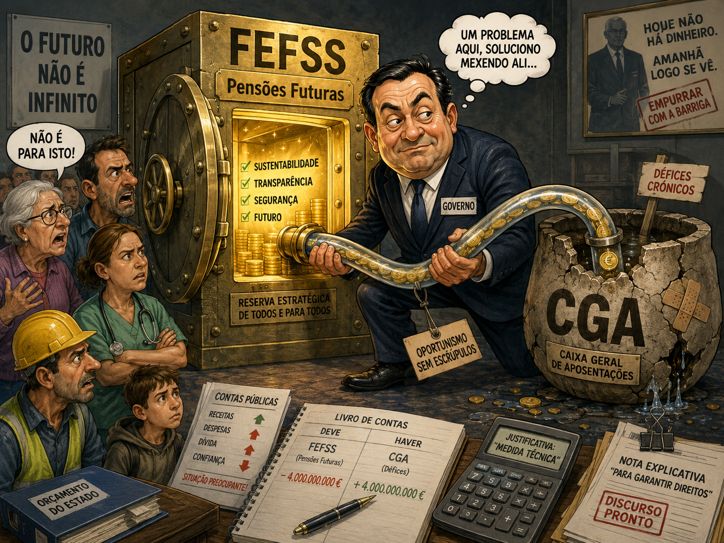
Don't Touch the Pension Vault
The financial promiscuity between Social Security and the CGA, and the State's old temptation to solve one problem by opening the drawer next door
Opening note:
The August 2026 debate over pension sustainability has exposed a question that is not merely accounting:
how far can the State bring together, consolidate or cross-finance the responsibilities of Social Security,
the FEFSS reserve fund and the CGA without destroying transparency, trust and budgetary discipline?
There is an old rule of Portuguese politics that rarely fails.
Whenever the State discovers money accumulated in a fund, it immediately begins to discover excellent reasons to give that money a different purpose.
The money may have been reserved for a specific objective.
It may represent decades of prudence.
It may exist precisely to face future difficulties.
No matter.
There is a problem today.
There is a vault over there.
The mental connection is quickly established.
Then come the studies.
The commissions.
The interpretations.
The accounting consolidations.
The harmonisations.
The inevitable technical expressions that make respectable what, explained at a kitchen table, would sound rather simpler:
there is not enough money in one drawer and there is money in another.
The controversy now surrounding Social Security, the Caixa Geral de Aposentações and the Social Security Financial Stabilisation Fund therefore deserves far more attention than an accounting dispute among specialists.
We are talking about trust.
We are talking about pensions.
And we are talking about the elementary principle that money reserved for one responsibility should not quietly become the solution to another.
The vault holds €42 billion
At the end of 2025, the Social Security Financial Stabilisation Fund, the FEFSS, held around €42 billion.
In January 2026, the Government itself announced that the fund had been reinforced and presented that amount as a guarantee for the pensions of future generations.
The Government also explained that the fund's growth in 2025 resulted from budgetary allocations and investment returns, and that the amount was already sufficient to cover more than two years of pension payments.
Keep that expression in mind.
Pensions of future generations.
Public funds have a curious characteristic.
When they are presented to citizens, their purposes are crystal clear.
When money starts to be needed elsewhere, the boundaries suddenly become philosophical.
The FEFSS is not the State's current account
The FEFSS exists to help stabilise Social Security financially.
Official documentation treats it as a reserve designed to strengthen the long-term financial stability of the system and to provide a buffer for future pension expenditure.
It is not a current account.
It is not a fund for unexpected State expenses.
It is not a parallel budget.
And it certainly should not become a common cash box to be opened every time another scheme runs into trouble.
Which part of this principle is particularly difficult?
Apparently the part where €42 billion appears.
The CGA is a different story
The Caixa Geral de Aposentações represents historical commitments made by the State to public-sector workers.
Until 31 December 2005, workers covered by that system were enrolled in the CGA.
From 1 January 2006, new public employees were compulsorily enrolled in the general Social Security system.
Those already in the CGA remained there as long as they met the legal conditions.
The mathematical consequence of this decision was known from day one.
Fewer active workers contributing to the CGA.
More pensioners relative to contributors.
Own revenues progressively insufficient.
An increasing need for financing from the State.
This is not exactly a surprise unearthed from an Egyptian sarcophagus in August 2026.
It was a conscious political decision.
And political decisions have financial consequences.
The CGA is already sustained by the State Budget
The numbers are clear enough.
In 2025, the CGA received about €4.4 billion in employee and employer contributions.
But it received around €7.6 billion from the State Budget, of which approximately €6.96 billion was the budgetary contribution intended to balance the CGA financially.
There is therefore a reality that should not be hidden behind sophisticated terminology:
the CGA is not currently financed by its own contributions alone.
The State Budget bears a very large part of the burden.
And that is exactly how it should work if these liabilities arise from historical commitments assumed by the State.
Who promised should pay
The principle is remarkably simple.
The State made certain commitments to its workers.
Those commitments must be honoured.
This is not an attack on retired civil servants.
It is not about removing acquired rights.
Nor is it even about debating whether old schemes were more or less generous.
People worked for decades under a given set of rules.
The State must comply.
Full stop.
But honouring commitments does not mean arbitrarily choosing who pays the bill.
If a liability belongs to the State, it should appear clearly in the public accounts.
The State Budget.
Tax revenue.
Public expenditure.
Transparency.
No tricks.
The Portuguese art of convenient consolidation
Then comes the report produced by the working group created to assess pension sustainability.
Its coordinator, Jorge Bravo, argues that looking at Social Security and the CGA in isolation produces a misleading picture.
According to the group, if the systems are assessed jointly, a deficit of close to €2 billion emerges for 2025.
There is a legitimate intellectual argument here.
Since 2006, new public-sector workers have contributed to the general Social Security system while pensions for previous subscribers remain in the CGA.
Therefore, if we want to study the State's overall pension liabilities, a consolidated view makes sense.
So far, no objection.
The problem begins when consolidating information turns into mixing financial responsibilities.
Those are not the same thing.
We can look at both without putting our hands in both vaults
It is perfectly possible to publish:
the Social Security balance,
the CGA balance,
the annual State Budget transfer to the CGA,
the FEFSS assets,
and a consolidated view of the State's future pension liabilities.
All at the same time.
That is called transparency.
There is no need to erase financial boundaries in order to obtain an integrated view.
On the contrary.
The more complex the system is, the more clearly we need to know:
who receives, who contributes, who pays, and why.
If everything goes into a single accounting pot, one marvellous advantage appears:
nobody can tell exactly where the money came from.
The State is rather fond of that kind of innovation.
The dangerous word is fungibility
Money is fungible.
One euro is one euro.
That is precisely why earmarking rules matter.
Without them, any public reserve can finance anything.
If we accept the logic that all public pension schemes are ultimately one collective liability and that all reserves can therefore be used interchangeably, then the FEFSS ceases to be what citizens believed it to be.
It becomes a general reserve for the State's pension obligations.
That would be a major change.
And if anyone wants to make that change, they should say so explicitly.
Not hide it in a methodological footnote buried deep inside a technical report.
The money did not appear by spontaneous generation
Another simplification should also be corrected.
The €42 billion in the FEFSS is not made up exclusively of contributions from private-sector workers.
The fund has received surpluses from the contributory system, investment income and substantial transfers from the State Budget itself.
In 2025 alone, according to the Government, it received around €4.5 billion in allocations and generated approximately €1.5 billion in investment income.
Moreover, since 2006 new public-sector workers have also paid contributions into the general Social Security system.
So the crude division:
private-sector workers on one side, civil servants on the other
no longer accurately describes the system.
But that does not weaken the central argument.
It strengthens it.
Because it shows exactly why we need transparent accounts and clear rules on the destination of funds.
The fund exists for the future precisely because the future will be difficult
There is something particularly irresponsible about looking at a strong pension reserve and saying:
"It has too much money."
No.
A stabilisation fund does not have too much money simply because the current balance is positive.
It has accumulated money because tomorrow may bring deficits.
Portugal is ageing.
The ratio between workers and pensioners will change.
Contribution histories will change.
The economy will change.
Migration may change.
Employment may fall.
Crises will happen.
That is exactly why a reserve exists.
Using that reserve today to solve another problem merely because the reserve currently looks comfortable is the pension equivalent of dismantling the roof during a sunny week because there seems to be spare timber.
Irresponsibility begins when the future cannot vote
There is a political reason why this temptation is so persistent.
Today's pensioners vote.
Today's workers vote.
Today's budget problems appear on television.
Today's deficits annoy ministers.
The needs of 2045 do not vote.
The difficulties of 2055 do not organise demonstrations.
The contributors of 2060 may still be in primary school.
It is very easy to sacrifice future prudence in order to buy present comfort.
Governments change.
Parliaments end.
The bill remains.
And then we call spending the reserve 'sustainability'
Politics has some extraordinary words.
"Sustainability" is one of them.
It can mean saving today in order to pay tomorrow.
But apparently it can also end up meaning spending today what we saved for tomorrow.
Everything depends on the PowerPoint.
When a citizen builds retirement savings and then spends them on current expenses, nobody describes the operation as a "structural reform of household sustainability".
We call it what it is:
the savings were spent.
Fortunately, the State has consultants.
The report has an important point that should not be ignored
It would be intellectually dishonest to pretend there is no problem.
There is.
The CGA is a closed scheme.
Its contribution base will continue to disappear.
The working group itself estimates that between 2045 and 2050 the CGA will effectively run out of its own contribution revenues and depend on the State to finance the remaining pensions.
That has to be planned.
It has to be quantified.
It has to be incorporated into long-term budget projections.
There has to be a strategy.
But identifying a real problem does not legitimise every possible solution.
The State cannot pretend it only just discovered the CGA
This may be the most irritating part.
The CGA stopped accepting new subscribers in 2006.
Twenty years ago.
There have been governments of different political colours.
Budgets.
Reforms.
Stability programmes.
Cabinet meetings.
Parliamentary debates.
Sustainability reports.
Nobody can credibly claim surprise.
The State knew perfectly well that it was closing the door to new contributors in a scheme that would continue paying pensions for decades.
If that decision created a future budgetary need, then that need belongs to the State.
Not to whichever reserve fund happens to look healthiest when the invoice arrives.
This is where financial integrity begins to fail
Financial integrity does not merely mean avoiding theft.
It is far more demanding.
It means respecting the intended purpose of public money.
Showing separate accounts.
Not manipulating classifications to manufacture convenient narratives.
Not using reserves set aside for one generation to disguise the costs of another.
Not turning old political decisions into abstract "system problems" when the time comes to pay for them.
And above all:
not changing the rules after the money has already been accumulated.
Any State can manufacture a better-looking deficit if it is given enough freedom to redefine what belongs to what.
That is not sustainability.
It is creative accounting with a national coat of arms.
No crime has been demonstrated. The issue is trust.
This must be stated clearly.
As of 21 August 2026, there is no known final Government decision ordering the FEFSS to finance the CGA deficit.
What exists is a report, a recommendation to clarify the fund's rules and a political debate over the possible use of Social Security reserves.
The working-group coordinator himself has said that it is currently unclear exactly when the FEFSS may be used and which pensions it may finance.
So this is not a completed criminal act.
It is a political crossroads.
And it is precisely before a decision is taken that citizens should debate the principle.
After the money leaves the vault, the debate becomes archaeology.
The opposition has discovered the principle of separation
Opposition parties have criticised the joint treatment of the schemes and demanded explanations from the Government.
Very well.
The principle deserves to be defended regardless of which party is in office.
And here is something unusually radical that Portugal might try:
apply the same principle after the Government changes.
If the Socialist Party governs tomorrow, the rule should remain.
If the Social Democrats govern, the same.
If any other party governs, likewise.
Pension money does not change its nature depending on which parliamentary bench one occupies.
Revolutionary, apparently.
Public funds do not belong to the Government
This distinction should be taught to every minister on day one.
A Government administers public money.
It does not own it.
A public fund with a defined purpose is not political property available for whatever priority is most urgent this quarter.
Governments are temporary.
Funds embody commitments that cross governments.
That is exactly why rules exist.
If every executive could freely redefine the purpose of every reserve, then we would not really have separate funds.
We would merely have bank accounts with different names.
The taxpayer is not an infinite fiscal cow
There is also a question of fairness that cannot be ignored.
Employees contribute.
Employers contribute.
The self-employed contribute.
In return there is an implicit social contract:
those revenues finance social rights and pensions under defined rules.
The State should not treat that contract like an Excel sheet where columns can be moved around until the final result looks more comfortable.
Because every operation of that sort damages something far harder to rebuild than a balance:
trust.
Without trust, no pay-as-you-go pension system works well
Social Security works because active generations finance current benefits while believing future generations will do the same for them.
It is an intergenerational contract.
There is no individual bank account with each citizen's name on it holding every contribution in reserve.
Institutional trust is therefore essential.
If citizens begin to believe that:
rules change arbitrarily, funds are redirected between purposes, reserves are used whenever political needs arise, and balances are presented differently according to whichever narrative is required,
they will eventually ask:
"Why should I trust this system?"
That question is devastating for any pension system.
The worst reform would destroy trust in order to improve the accounts
We can reform parameters.
Retirement ages.
Rates.
Formulas.
Incentives.
Complementary schemes.
All of that can be debated.
But a reform that creates the impression that the State can simply take an accumulated reserve and redirect it to another hole creates an invisible form of damage.
Even if the accounting works.
Institutional credibility does not appear in the spreadsheet.
Until it disappears.
The solution does not require magic
The path seems fairly obvious.
First: fully separate accounts.
Social Security on one side.
The CGA on the other.
The FEFSS clearly identified.
Second: an additional consolidated view.
The State should publish the totality of its future pension obligations so that nobody can pretend the CGA deficit does not exist.
Third: transparent State Budget financing of the CGA.
It is a historical obligation of the State.
It should appear as such.
Fourth: explicit rules for the use of the FEFSS.
When it can be used.
Which benefits it may finance.
Under what circumstances.
With what limits.
Who authorises it.
Whether and how the fund must be replenished.
Simple.
Readable.
Auditable.
Solidarity does not require financial promiscuity
Someone will argue that it is all the State.
All pensions.
All Portuguese citizens.
Therefore separation is artificial.
No.
Solidarity does not require bad accounting.
We can be solidaristic and still know who pays.
We can guarantee CGA pensions and show exactly what they cost.
We can guarantee Social Security pensions and protect its reserve.
We can maintain robust public systems without turning every revenue source into an indistinguishable financial soup.
In fact, transparency is what makes solidarity sustainable.
When everything pays for everything, nobody is accountable for anything
This may be the central disease of public finance.
If an expenditure clearly belongs to a programme, we can evaluate it.
If a fund has a clear mission, we can audit it.
If a transfer has a known origin and destination, we can judge it.
But when everything starts financing everything:
responsibility dissolves.
The next Government blames the previous one.
The ministry blames the system.
The system blames demography.
Demography, mercifully, does not give interviews.
And the taxpayer pays.
The CGA deserves sustainability. The FEFSS deserves protection.
There is no contradiction between these two statements.
CGA pensioners have legitimate rights.
Future Social Security pensioners do too.
The State must honour both.
The budgetary difficulty of one commitment does not reduce the legitimacy of the other.
Governing means facing these choices.
Not finding a vault and pretending the problem has disappeared.
A serious country does not hide its commitments
A financially honest State should tell citizens:
We have this obligation to the CGA.
It costs this much.
It will evolve in this way.
It will be financed in this way.
We have this Social Security reserve.
It is worth this much.
It is intended for these situations.
It may not be used for those.
Full stop.
Perhaps that is too simple.
Portugal has a complicated relationship with solutions that fit in four lines.
The vault will always attract anyone with a problem
Today it is €42 billion.
Tomorrow it may be €50 billion.
The larger the FEFSS becomes, the greater the political temptation.
A recession.
A budget deficit.
A more expensive CGA.
An urgent social programme.
A particularly creative election campaign.
There will always be a good reason.
That is exactly why public funds need high legal walls.
Not to protect them when nobody needs them.
To protect them when everybody does.
Don't touch the vault
The Social Security Financial Stabilisation Fund exists because somebody, at some point, understood a remarkably sensible idea:
good times do not last forever.
When there are surpluses, part of them is saved.
When demographic pressure arrives, a cushion exists.
That is called prudence.
Destroying that prudence in order to solve liabilities known for twenty years would deserve a different name.
Irresponsibility.
Not merely financial.
Intergenerational.
Each problem in its own account
Does the CGA have a structural problem?
Acknowledge it.
Quantify it.
Finance it through the State Budget.
Does Social Security have surpluses?
Show them.
Is the FEFSS accumulating reserves?
Protect them.
Does the combined system have future liabilities?
Publish them.
There is no need to choose between transparency and sustainability.
We need both.
What we do not need is the old national speciality:
mixing cash boxes until nobody understands who paid for what.
Because money has a memory
Every euro accumulated in a fund represents earlier decisions.
Contributions.
Savings.
Surpluses not spent.
Investment.
Deferred consumption.
It is money taken away from present use in order to protect the future.
Public funds should therefore have institutional memory.
They should remind Governments:
"This money already had a purpose before you arrived."
A healthy sentence for any administration.
The State cannot be the first to break the contract
We demand that citizens comply.
Pay taxes.
Contribute.
Respect contracts.
Plan for retirement.
Act responsibly.
Then the State itself must behave according to even higher standards.
It is not enough for an operation to be legally possible.
It must also be institutionally sound.
There are perfectly legal decisions that are deeply imprudent.
And there are perfectly legal accounting devices that can destroy trust for decades.
Responsibility does not move with the money
This is the central question.
The CGA was closed to new entrants in 2006.
The decision was made by the State.
The consequences were predictable.
The State must own them.
It cannot, twenty years later, look at another reserve and retroactively discover that those liabilities somehow always belonged to every available public fund.
That is not reform.
It is a transfer of responsibility.
Moving the bill does not erase who created it.
Don't touch the pension vault
The debate over Social Security sustainability is necessary.
It is urgent.
It should be serious.
Portugal faces demographic ageing.
Different contribution histories.
Technological change.
New forms of work.
Migration.
Deep economic change.
We need to discuss all of it.
But precisely because the future will be difficult, there is one thing we should not do:
confuse an existing reserve with permission to postpone hard decisions.
The FEFSS is not money discovered in a drawer.
The CGA is not a surprise.
And the State Budget cannot disappear from the equation simply because directly financing historical commitments makes the public accounts politically less attractive.
If the State promised, the State pays.
Transparently.
In full view of citizens.
No cross-funding.
No financial alchemy.
No accounting promiscuity.
A responsible Government does not ask:
"Where is there money we can use?"
It asks:
"Whose responsibility is this, and how should we finance it fairly?"
The difference may look small.
It is the difference between governing a country and merely managing the next difficulty.
And the €42 billion in the stabilisation fund does not exist to make one Government's life easier in 2026.
It exists to make the retirement of millions of Portuguese citizens less uncertain in decades that have not yet arrived.
Don't touch the vault.
A responsible Government does not ask where there is money it can use. It asks whose responsibility it is and how that responsibility should be financed fairly.
KEY FACTS
- At the end of 2025, the FEFSS held around €42 billion, according to the Portuguese Government, an amount presented as a reserve for future pensions and sufficient to cover more than two years of pension expenditure.
- In 2025, the FEFSS portfolio grew by roughly €6 billion, including approximately €4.5 billion in public allocations and €1.5 billion in investment returns.
- From 1 January 2006, new public employees were moved into the general Social Security system, effectively closing the CGA to new entrants under Law no. 60/2005.
- In 2025, the CGA recorded about €4.4 billion in employee and employer contributions and around €7.6 billion in State Budget transfers, including roughly €6.96 billion for financial balancing.
- The pension-sustainability working group argued in August 2026 for a joint reading of the CGA and Social Security and estimated a deficit close to €2 billion for 2025 under that consolidated approach.
- The same group argued that the mandate of the FEFSS should be clarified, including when the fund may be used and which pension liabilities it may finance.
- As of 21 August 2026, the public debate concerns proposals, methodology and future rules; there is no publicly known final decision ordering the use of the FEFSS to pay the CGA deficit.
Editorial Note
This is an opinion and political commentary column by Francisco Gonçalves, updated on 21 August 2026.
The criticism focuses on the possibility of blurring, consolidating or cross-financing the financial responsibilities of Portugal's Social Security system, the Social Security Financial Stabilisation Fund (FEFSS) and the Caixa Geral de Aposentações (CGA), while defending separate accounts, an additional consolidated view and transparent State Budget financing of historical public liabilities.
The article does not state that a final Government decision has been taken to use the FEFSS to finance the CGA deficit, nor does it allege a specific criminal offence. Expressions such as "accounting promiscuity", "creative accounting" and similar formulations are editorial opinion. Verifiable claims — including the size of the FEFSS, the closure of the CGA to new entrants, State Budget transfers and the current debate over the fund's mandate — are documented in the references below.
Editorial co-authorship and source research: Augustus Veritas, an AI assistant from OpenAI.
Credible References
- Government of Portugal — Government reinforces the pension fund by €5.5 billion (21 Jan. 2026)
- Portuguese Social Security — FEFSS Annual Report 2024
- CGA — Eligibility / registration rules since 1 January 2006
- Law no. 60/2005 of 29 December — Convergence of public-sector social protection
- UTAO — Budget Execution: January to December 2025
- CGA — Mission and scope of the convergent social-protection scheme
- Renascença — Good financial performance of Social Security is 'an illusion' (18 Aug. 2026)
- Renascença — What does the Social Security Working Group propose? (18 Aug. 2026)
- Renascença — Opposition parties criticise the Social Security report (18 Aug. 2026)
- Renascença — Government receives final report on Social Security sustainability (13 Jul. 2026)
Francisco Gonçalves
Fragmentos do Caos
FC-Chronic-News
Column on Social Security, the FEFSS, the CGA and public-finance responsibility.
August 2026.