
Vigilant Guard: Giving AI Eyes to ZoneMinder Without Handing Your Home to the Cloud
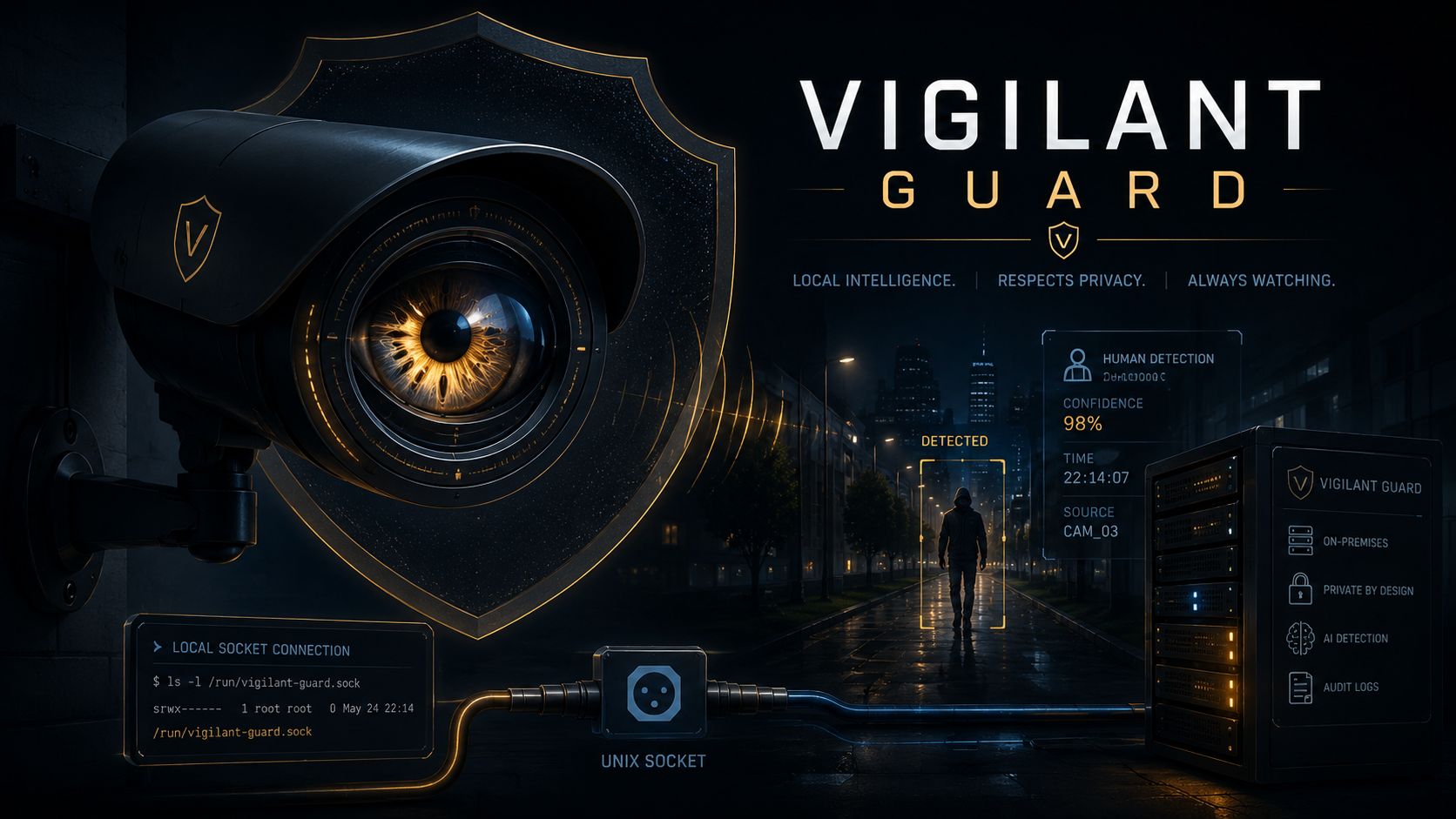
FACT BOX
- Solution name: Vigilant Guard.
- Purpose: detect humans in ZoneMinder events using local AI.
- Main engine: YOLOv8 running on CPU.
- Integration: ZoneMinder filter → shell script → UNIX socket → Python service.
- Alerts: ntfy notifications to mobile devices or compatible clients.
- Facial recognition: optional, using a MySQL/MariaDB database.
- Philosophy: no mandatory cloud, no external dependency, full local control.
Vigilant Guard: Giving AI Eyes to ZoneMinder Without Handing Your Home to the Cloud
Vigilant Guard was born from that practical need: to add to ZoneMinder a local artificial intelligence layer capable of analysing motion events, detecting humans and sending useful alerts to a mobile phone, without relying on external services, closed platforms or cloud-based surveillance.
The idea is simple, yet powerful: ZoneMinder continues to do what it does well — capturing video, detecting motion and creating events. Vigilant Guard then steps in as a second observer, more selective, more attentive and less easily impressed by nocturnal shadows.
1. The classic problem of domestic video surveillance
Anyone who uses video surveillance systems knows the dilemma: if sensitivity is too low, the system misses important events; if sensitivity is too high, it starts firing alerts for everything and nothing. A cloud passes in front of a light, a tree moves, an insect crosses the lens, and the system enters apocalypse mode.
ZoneMinder is a robust and flexible tool, but traditional motion detection is mainly based on image changes. That is enough to understand that "something changed", but not enough to understand what changed.
That is exactly where Vigilant Guard enters the picture: it does not replace ZoneMinder; it adds discernment.
2. General architecture of the solution
The architecture was designed to be simple, local and auditable. No cloudy magic running on distant servers. Everything runs inside the user's own infrastructure.
ZoneMinder
   ↓
Event filter
   ↓
notify-image.sh
   ↓
UNIX socket /tmp/humans_socket
   ↓
Vigilant Guard
   ↓
YOLOv8
   ↓
optional face_recognition
   ↓
optional MySQL/MariaDB
   ↓
ntfy / crops / alerts
ZoneMinder creates the event. A filter executes the notify-image.sh script. That script sends the event path to a UNIX socket. The Python service Vigilant Guard receives that path, analyses critical images such as alarm.jpg and snapshot.jpg, detects human presence with YOLOv8 and sends an alert via ntfy.
The chain is short, clear and debuggable. And, like all good UNIX systems, when it fails, it leaves clues — provided we have enough logs and the patience of a craftsman.
3. The role of the UNIX socket
One of the most important design decisions was to use a local UNIX socket instead of HTTP, REST APIs or another heavier mechanism. The socket is fast, simple and well suited for communication between processes on the same machine.
The socket path used is:
/tmp/humans_socket
There was, however, a critical detail: ZoneMinder runs the filter as the www-data user, while the Python service runs as root. If the socket is created as root:root with restrictive permissions, the ZoneMinder script cannot deliver events.
The solution was to create the socket with the www-data group:
srw-rw---- 1 root www-data ... /tmp/humans_socket
This small detail is the kind of thing that separates a system that is "almost working" from one that is truly operational. Computing, like life itself, is often lost at a door closed by permissions.
4. Human detection with YOLOv8
The main detection engine is YOLOv8, using the lightweight yolov8n.pt model. This choice was deliberate: the system runs on a virtual machine without a dedicated GPU, so the solution had to work on CPU.
A typical configuration is:
HUMANS_YOLO_MODEL=/opt/VigilantGuard/models/yolov8n.pt
HUMANS_MAX_EVENT_FRAMES=4
HUMANS_MAX_IMAGE_WIDTH=960
HUMANS_PERSON_CONF=0.35
HUMANS_MIN_PERSON_AREA_RATIO=0.003
The HUMANS_PERSON_CONF parameter controls the minimum confidence required from the model. Lower values increase sensitivity, but may also increase false positives. Higher values reduce noise, but may miss people in dark, partial or distant images.
The goal is to find a balance: detect well enough without turning every shadow into a domestic emergency.
5. Why analyse alarm.jpg and snapshot.jpg
Within a ZoneMinder event, not all images have the same value. Some may be empty, delayed or captured before the person is clearly visible. For that reason, Vigilant Guard gives priority to two essential images:
alarm.jpg— usually the image associated with the alarm moment.snapshot.jpg— the event reference image.
The logic was adjusted to ensure that both images are analysed whenever they exist. Only afterwards are additional event images selected across the sequence.
This improves the probability of detecting a person, especially when the person passes quickly in front of the camera.
6. Optional facial recognition
After detecting a person, the system can attempt to identify the face using the face_recognition library, comparing facial encodings with a MySQL or MariaDB database.
The table may have a simple structure:
CREATE TABLE faces (
    id INT AUTO_INCREMENT PRIMARY KEY,
    name VARCHAR(255) NOT NULL,
    encoding MEDIUMTEXT NOT NULL,
    created_at TIMESTAMP DEFAULT CURRENT_TIMESTAMP
);
Facial recognition is, however, optional. The solution remains useful without it: it detects humans, crops the figure and sends an alert. Named identification only happens when there is a visible face, with sufficient quality, previously registered in the database.
In practice, YOLO answers the question: "Is there a person?". Facial recognition then tries to answer the next question: "Who is it?".
7. Alerts via ntfy
Alerts are sent through ntfy, a simple and lightweight solution particularly well suited for notifications in self-hosted systems.
A typical message may indicate:
👤 Human figure detected — http://server/uploads/human_20260529_xxxxx.jpg
Or, when a face is recognised:
🧑 Face identified: Name — http://server/uploads/face_name_xxxxx.jpg
The result is a very practical surveillance chain: the camera sees, ZoneMinder creates an event, Vigilant Guard confirms whether there is a human, and the mobile phone receives only what matters.
8. systemd service: turning a script into a sentry
To run continuously, Vigilant Guard operates as a systemd service:
sudo systemctl status Vigilant-Guard.service
sudo journalctl -u Vigilant-Guard.service -f
The service creates the socket, loads known faces, initialises the YOLO model and waits for event paths sent by the ZoneMinder script.
Using systemd allows automatic restart, CPU limits, lower scheduling priority and clean integration into the system boot process.
9. Limits and tuning
Vigilant Guard does not solve every video surveillance problem by itself. If ZoneMinder does not create an event, Vigilant Guard will not be called. The first link in the chain remains the configuration of zones, sensitivity, minimum area and motion criteria inside ZoneMinder itself.
Tuning happens at two levels:
- In ZoneMinder: detection zones, sensitivity, ignored areas, minimum alarm frame count.
- In Vigilant Guard: YOLO confidence, minimum person area, number of images analysed per event, maximum image width.
If the system detects too many people — for instance, pedestrians in the street — the first solution should be to adjust the zones in ZoneMinder. It is better to prevent an unwanted event from being created than to ask AI to compensate for poor surveillance geometry.
10. A local, simple and publishable project
Vigilant Guard was born from a concrete need, but it has the potential to be useful to other ZoneMinder users. Many people want to add human detection to their cameras, but do not want to depend on closed platforms, subscriptions, mandatory cloud services or commercial black boxes.
This solution follows a different philosophy: local software, explicit configuration, readable logs, simple integration and full control by the user.
It does not aim to be a universal intelligent surveillance platform. It aims to be a clear, small and effective tool: receive events, analyse images, detect humans and send alerts.
Conclusion: a digital watchman with new eyes
Vigilant Guard represents a pragmatic way of adding artificial intelligence to ZoneMinder without dismantling the existing architecture. Instead of replacing the video surveillance system, it adds a layer of interpretation.
The result is a more attentive digital watchman: it does not merely see movement, but tries to understand whether that movement corresponds to a person.
And perhaps that is the best definition of this small solution: a wide-awake night watchman, powered by Python, YOLO, UNIX sockets and a certain amount of technical stubbornness. The good kind of stubbornness — the artisanal kind that turns small problems into useful systems.
Author: Francisco Gonçalves
Technical and editorial co-authorship: Augustus Veritas.Technical article published within the experimental technology, open software, local artificial intelligence and independent infrastructure projects of Fragmentos do Caos.