
European Open-Source Manifesto: The Liberation of Public and Private Software
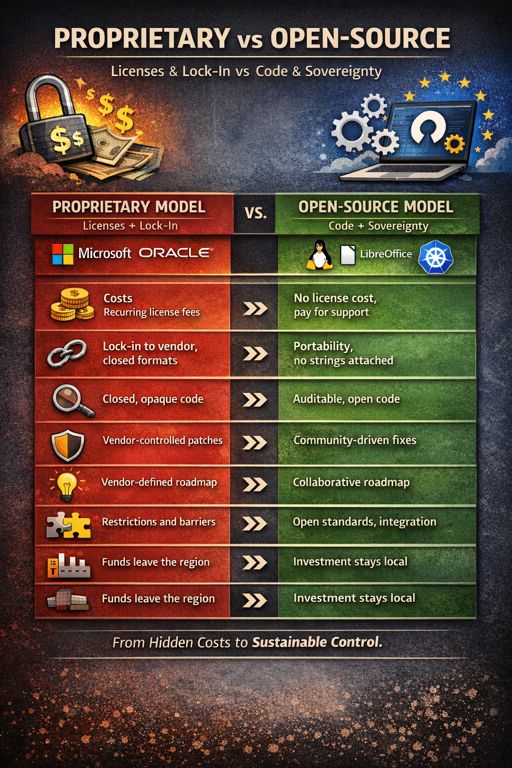
- Problem: structural dependency on proprietary vendors and annual licensing "rents".
- Consequence: lock-in, recurring costs, forced migrations and reduced technological autonomy.
- Solution: a European open-source movement with funding, teams, standards and an active community.
- Objective: pay for European support and engineering — not perpetual tribute.
- Principle: open formats, interoperability and portability as mandatory rules in public procurement.
- Expected result: savings, resilience, auditable security and real digital sovereignty.
European Open-Source Manifesto
The Liberation of Public and Private Software
I. Europe Pays Rents — and Calls Them "Normality"
For decades, much of Europe's institutional and corporate fabric has lived within an invisible economy: the economy of licenses, renewals, and contracts multiplying like ivy across public budgets. This is not merely cost. It is dependency. It is an imposed agenda. It is forced migration whenever a vendor decides the world must rotate according to its commercial calendar.
When this happens, Member States do not choose — they comply. And when compliance lasts long enough, it begins to feel "natural". That is called stability. We call it technological submission.
II. Open-Source Is Not a Religion — It Is a Strategy
Open-source is not "free software". It is sovereign software: auditable, evolvable, shareable, supportable by many companies — not owned by one. It is the difference between a house with a single key (held by someone else) and a house whose blueprint belongs to you.
Europe has everything required to turn this into a historic movement: universities, research centres, technology firms, integrators, and a critical mass of talent that lacks only one thing — a courageous plan.
III. The European Open-Source Movement: A Distributed "Software Airbus"
What we propose is not a closed project nor a portal that dies after two reports. It is an ecosystem: funding, standards, field teams, certification, intelligent public procurement and a community that does not abandon anyone mid-journey.
IV. A 10-Point European Plan (with timeline)
- European Open-Source Migration Fund (FEMOS): finance diagnosis, pilots, migration and support.
- European Transition Corps: expert teams in Linux, virtualization, networking, IAM, databases and security.
- Certified European Stack Catalogue: tested operating systems, collaboration tools, databases and BI.
- Anti-lock-in public procurement rules: open formats, portability and interoperability.
- Pay support — not tribute: replace licenses with European engineering contracts.
- European training and certification programmes.
- Mandatory upstream contribution for publicly funded software.
- "SME First" programme with remote migration support.
- Security by design: audits, SBOM, coordinated vulnerability response.
- Public metrics dashboards: savings, progress and skilled-employment impact.
V. A Realistic Timeline
0–6 months: fund creation, core team, initial stacks, procurement reform.
6–12 months: national pilots in public administration, education and healthcare.
12–24 months: scale desktops, identity, email and collaboration.
24–48 months: databases, ERP/BI and full open-standards consolidation.
48+ months: a mature, autonomous European software ecosystem.
VI. What This Means for Predatory Multinationals
This is not revenge. It is balanced negotiation. When real alternatives exist, the market ceases to be a narrow corridor and becomes an open square. Rents fall. Arrogance fades. Innovation becomes mandatory again.
VII. Epilogue: Europe as a Workshop of the Future
The European Union was born to prevent wars and foster convergence. Today, convergence means technology — autonomy, auditable security, and the power to decide. If Europe wishes to be an adult civilisation, it must sign its own code.
This manifesto is an invitation: less fear, less servitude, more construction.
Freedom is an operating system.
And Europe already has the processor, memory and network required to run it.
Benefits Overview: Proprietary vs Open-Source
Below is a pragmatic, decision-oriented summary. It does not claim one model is universally "better" in every scenario: it highlights where each model typically excels — and where its hidden costs tend to appear.
- Single-vendor accountability: clear contractual responsibility and escalation paths.
- Integrated "suite" experience: tight coupling across tools (sometimes reducing integration effort).
- Perceived simplicity for procurement: standardised licensing and vendor-led roadmaps.
- Vendor-provided compliance artifacts: documentation, attestations, and enterprise support bundles.
- Short-term onboarding speed: quick adoption when organisations are already aligned to the vendor ecosystem.
- Digital sovereignty: portability, independence, and freedom to change providers.
- Auditability & transparency: code review, independent audits, and verifiable fixes.
- Cost structure control: spend shifts from "rent" to support, engineering, and training.
- Interoperability-friendly: strong alignment with open standards and ecosystem integration.
- Innovation leverage: roadmap can be influenced by contributions and public funding priorities.
- Local economic impact: budgets support local integrators, SMEs and skilled jobs.
Open-Source References and Key Communities
The sources below are recognised open-source foundations and projects widely used by governments, universities, and critical industries worldwide. They are based on open code, open licences and active communities.
-
Linux Foundation
Global ecosystem for enterprise-grade open-source projects (Linux, Kubernetes, OpenSSF, Hyperledger, etc.)
https://www.linuxfoundation.org -
Free Software Foundation (FSF)
Origin of the free software movement — GNU, GPL licences, and user freedom principles.
https://www.fsf.org -
Free Software Foundation Europe (FSFE)
Promotes software freedom in Europe, including public sector and digital sovereignty initiatives.
https://fsfe.org -
Open Source Initiative (OSI)
Maintains the Open Source Definition and approves open-source licences.
https://opensource.org -
OSOR — Open Source Observatory and Repository (EU)
EU public sector open-source observatory and repository.
https://joinup.ec.europa.eu/collection/open-source-observatory-osor -
European Open Source Academy
Training, governance and adoption models for open-source in Europe.
https://www.opensourceacademy.eu -
Nextcloud
European open-source collaboration and private cloud platform.
https://nextcloud.com -
LibreOffice / The Document Foundation
Productivity suite built around open standards and long-term document portability.
https://www.libreoffice.org -
PostgreSQL
Enterprise-grade open-source database, widely adopted across public and private sectors.
https://www.postgresql.org -
Apache Software Foundation
Major infrastructure projects (HTTP Server, Kafka, Hadoop, Airflow, and more).
https://www.apache.org -
Eclipse Foundation
Open-source platforms across enterprise software, IoT and cloud ecosystems.
https://www.eclipse.org -
Debian Project
One of the most stable and widely used Linux distributions for servers and institutions.
https://www.debian.org -
Fedora Project
Upstream innovation and a base for multiple enterprise Linux ecosystems.
https://getfedora.org -
Kubernetes
The open-source standard for container orchestration across cloud and edge computing.
https://kubernetes.io
with co-authorship by Augustus Veritas — Fragmentos do Caos News Team