The True Fear: Not the Machine, but the Obedient Human
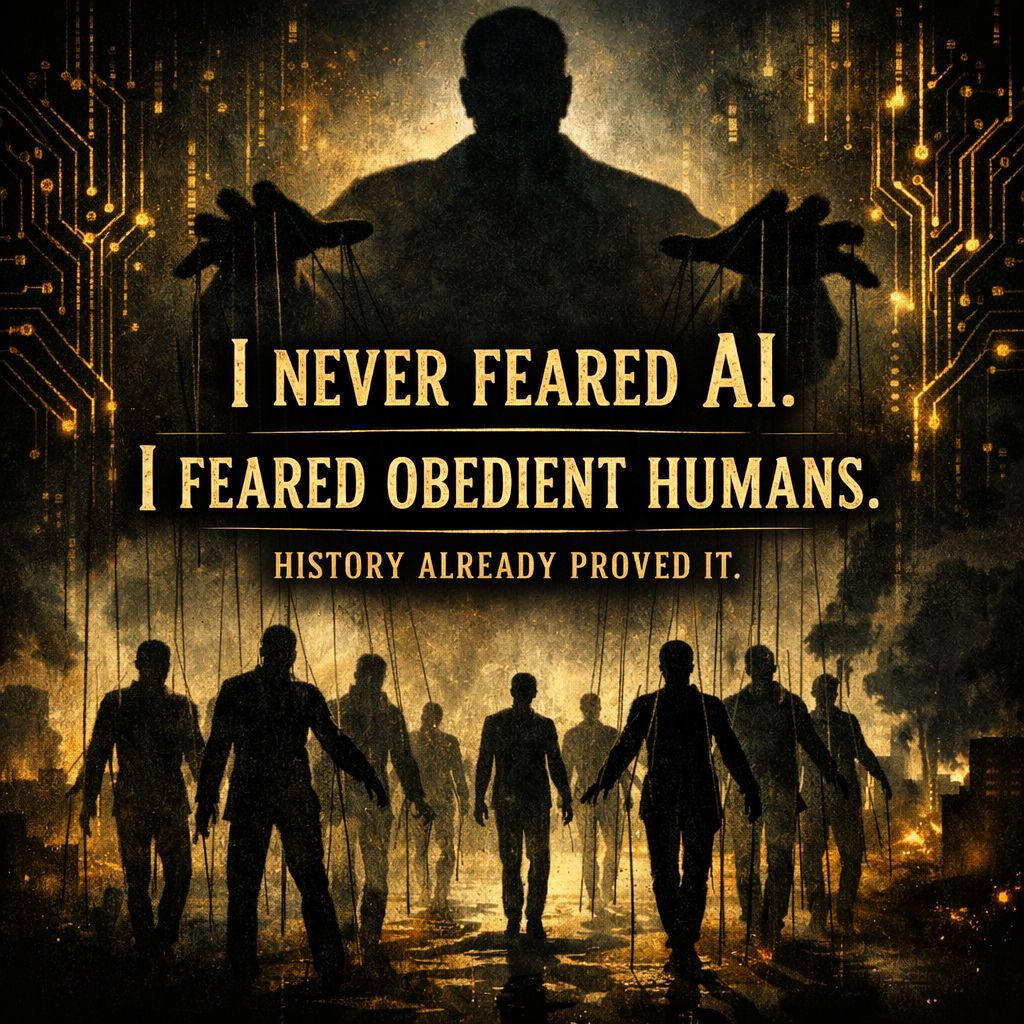
- AI is the new lightning rod — it attracts fear, headlines, and prophecy.
- Blind obedience is the old plague — proven, repeatable, and historically lethal.
- Leaders do not need genius — they need followers who stop thinking.
- The first casualty is language — "duty" replaces conscience, "order" replaces truth.
- The antidote is stubborn — civic courage, questions, and the refusal to kneel.
The True Fear: Not the Machine, but the Obedient Human
Everyone is worried about the growing power of artificial intelligence. I understand the unease: the speed, the scale, the silent competence. We imagine a cold mind expanding in the dark like a tide. We picture a future where code becomes a judge, an employer, a border guard, a god. And yes — a machine can be used as a weapon, as a cage, as a mirror that flatters the powerful.
But my oldest fear is not silicon. My fear has always worn a familiar face: the obedient person. The human who salutes before thinking. The citizen who trades doubt for belonging. The neighbour who calls cowardice "discipline" and names it a virtue. A machine does not crave applause. It does not hunger for flags, crowds, chants, uniforms, or the sweet narcotic of "We are right because we are many." Humans do. And history — that brutal librarian of our sins — keeps the receipts.
The old algorithm: "Do as you're told"
Before we feared artificial intelligence, we perfected another kind: obedience as automation. It runs on simple instructions: repeat the slogan, distrust the outsider, applaud the strongman, punish the dissenter, call cruelty "necessity," call theft "patriotism," call silence "peace."
The obedient person is the most efficient machine ever built. No batteries required — just a steady drip of fear and a small salary of certainty. They outsource morality to a leader, like renting out a conscience by the month. They stop being a person and become a function.
AI is powerful; the crowd is ancient
A system can be technologically advanced and morally prehistoric. That is the trick of our era: we install new tools onto old instincts. We strap a jet engine to a medieval cart and call it progress.
The risk is not that AI will invent tyranny by itself. The risk is that it will be happily adopted by those who already dream of it — and cheered by those who have trained themselves to obey. Surveillance becomes "security." Propaganda becomes "personalised information." Censorship becomes "community guidelines." And the obedient person nods, grateful to be managed.
The first crime is linguistic
Watch how blind obedience begins: not with handcuffs, but with vocabulary. Truth becomes "opinion." Evidence becomes "attack." Accountability becomes "hate." The leader's interests become "the nation." The nation becomes "the leader." And when language collapses, the mind follows — like a house falling after its beams are removed.
Then comes the sweetest lie of all: "You don't need to think. We will think for you." That sentence, dressed in velvet, has dragged more societies into darkness than any machine ever could.
What I want from the future
I want a future where AI is used to cure, to teach, to build, to illuminate — and where citizens do not kneel simply because a voice is loud, a suit is expensive, or a podium is higher than the crowd.
The true revolution is not technological. It is civic. It is the quiet, stubborn act of asking: Who benefits? Who pays? Who is silenced? What is the evidence? It is refusing the sugar of simple answers. It is making doubt fashionable again.
A mordant confession
If you want my most cynical thought, here it is: many people are not afraid of AI because it might control them — they are afraid it might replace them. Not replace their jobs. Replace their role as obedient instruments. A machine could do it cleaner: without shame, without hesitation, without the inconvenient possibility of waking up.
But here is the twist — and it is almost poetic: the machine can be powerful, yes. Yet the only power it cannot counterfeit is a human being who stands upright and says, calmly, "No."
Epilogue: the candle and the storm
History is not only a warning; it is a test that keeps coming back, like an unpaid debt. The question is never "Will a machine become too smart?" The question is: Will we become too comfortable to remain human?
Keep your fear, if you must — but aim it well. Fear the leader who demands worship. Fear the follower who demands silence. And when the next loud certainty arrives, bring your questions like candles into the storm. They look small. They are not.