
PhDs: from paper to prototype — and China shifting gears
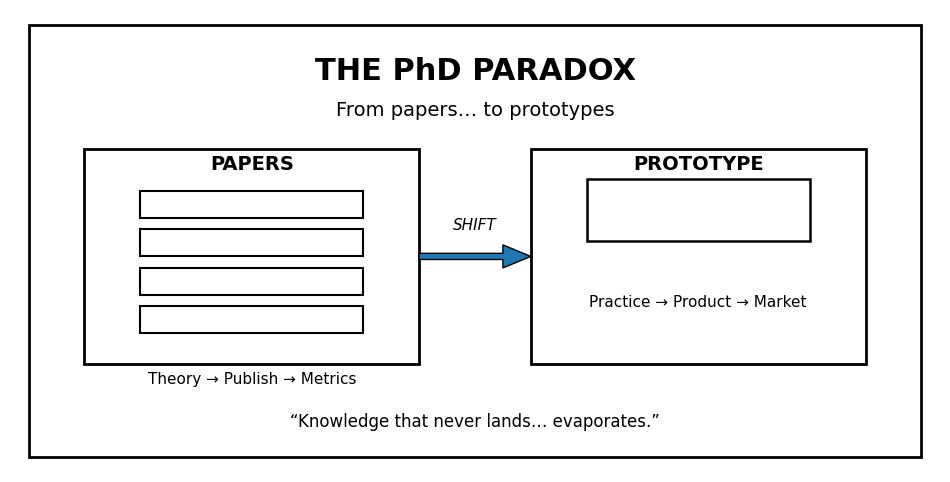
- Part of the West has adopted (or tolerated) "publication-based" doctorates: stacks of papers standing in for a thesis — with growing criticism about equivalence and quality.
- In China, signs of a pivot are emerging: standards and pilot programmes that favour applied results, engineering-oriented dissertations and, in specific cases, completion via product/design instead of a classic thesis.
- The bet connects to a bigger strategy: shorten the path between lab, prototype and market — and reduce "showcase innovation".
- The risk is not practice itself: the risk is practice also becoming theatre (cardboard prototypes, rigged metrics, "demos" without substance).
Doctorates: from paper to prototype — and China shifting gears
In the West, the doctorate has many virtues: rigour, method, patience, depth. But it also has a vice that turned into habit — and, like all habits, it begins as convenience and ends as culture: the cult of the paper as an end in itself.
The outcome is familiar: brilliant theses that never touch the ground, elegant theories without bolts, models heavy on "state of the art" and light on "state of the world". And then, when someone tries to turn that into something concrete — a physical prototype, a robust system, a sellable product — they discover the road from idea to impact is long, expensive and, very often, reserved for a few.
The "paper" is not the enemy — exclusivity is
A paper is a noble artefact: it condenses knowledge, forces clarity, enables scrutiny. The problem begins when the system rewards only text — as if reality were an optional appendix.
The very idea of a "PhD by publication" (the cumulative thesis) has been widely debated: scientific output is stacked, but unity, conceptual maturity, or the same level of demanding synthesis as a classic dissertation is not always guaranteed. When the metric commands, thought obeys — and the doctorate can become an assembly line of PDFs.
China pulling the doctorate into the real world
What I'm describing — "moving from theory to practice with prototypes and market-facing innovation" — fits a broader movement that has surfaced in Chinese standards and pilot schemes, especially in engineering and strategic sectors.
There are guidelines for professional doctorates in engineering with an explicit focus on applications and independent practice; and, in parallel, experiments are appearing where completion may be based on a product or design, rather than the classic ritual of a written thesis. This is not a "pedagogical whim": it is geopolitical and economic pressure knocking on the university door and demanding results with legs — and, ideally, with wheels.
When a country wants to shorten the cycle "idea → prototype → industrialisation → exports", it tweaks the gears where time is lost. And one of those gears is this: training PhDs who are not only able to explain — but also to build, test, fail fast and improve. And the faster they fail, the sooner the next attempt arrives... until success is reached!
City speed vs. cruising speed
Perhaps the perfect metaphor for this methodology is: city speed is when every junction has bureaucratic traffic lights, academic checkpoints, endless "approvals", and a culture that treats the prototype like a tourist: "you may visit, but you may not move in."
cruising speed is when theory does not lose elegance — it simply gains friction with the real. The doctoral candidate stops being merely a producer of arguments and becomes an engineer of consequences.
At the limit, the question stops being: "How many chapters does it have?" And becomes: "What works? What measures? What holds up? What improves someone's life — and how many?"
The danger: swapping one liturgy for another
There is an essential caution: an applied doctorate cannot turn into a contest of "trade-fair demos". Prototypes can be as decorative as papers — if the system rewards appearance rather than substance.
The solution is not to kill rigour — it is to change the kind of rigour: rigour of testing, validation, technical reproducibility, measurable impact, integration with industry without the university being captured, ethics without cynicism.
And the West? It has a future — if it accepts learning
The irony is that the West has everything it needs to lead: extremely strong scientific ecosystems, top universities, a critical culture, international networks. What is missing, in many cases, is aligned incentives: also rewarding those who build, integrate, transfer technology, create spinoffs, validate in the field, and deliver things that withstand the world — not just peer review.
Because, in the end, a thesis that never leaves the shelf is like a boat that never touches water: it may be a masterpiece… but it remains furniture.
Epilogue: the future will demand proofs, not promises
The world has entered a phase where "innovation" stopped being a slogan: it is economic survival, strategic autonomy, response capacity. If China is reshaping the doctorate to bring theory closer to product, that is not poetry — it is engineering of destiny.
And perhaps this is what the 21st century whispers (or shouts): knowledge that does not land, evaporates. The rest is paper — however noble it may be.
- South China Morning Post (24 Nov 2025) — pilot allowing graduation with product/design instead of a thesis: link
- Government of China / english.gov.cn (30 Oct 2024) — guidelines for professional doctorates in engineering, focus on applications and practice-oriented outputs: link
- People.cn (31 Oct 2024) — summary of regulation for professional doctorates in engineering: link
- China Daily (11 Dec 2025) — university–industry integration and strengthening engineering programmes (masters/doctorates) with co-leadership from companies: link
- Times Higher Education (28 Nov 2025) — critical debate on "PhDs by publication" and equivalence versus the traditional thesis: link
- Nature (18 Jan 2023) — "PhD training is no longer fit for purpose — it needs reform now": link
- European University Association (EUA) — principles of "Innovative Doctoral Training" (exposure to industry and relevant sectors, among others): link