
The Universe That Slows: The Hidden Breath Before the Fall
FACT BOX
- New data suggest the universe's expansion may be slowing down.
- Primordial black holes (PBHs) could drive a temporary cosmic acceleration.
- The Milky Way and Andromeda are already converging — a local echo of a slowing cosmos.
The Universe That Slows: The Hidden Breath Before the Fall
1. Cosmic Deceleration
For over two decades, the standard model of cosmology has assumed that the universe expands ever faster, driven by an enigmatic dark energy. Yet recent analyses of Type Ia supernovae point to a turning point: the cosmic expansion might already be slowing down. What once was hailed as proof of eternal acceleration could, in truth, be the prelude to a grand return.
2. The Role of Primordial Black Holes
Primordial black holes (PBHs) — born in the first instants after the Big Bang — may serve as cosmic regulators. Through subtle energy exchange with the intergalactic medium, they create a transient "negative pressure," mimicking dark energy. When this effect fades, gravity quietly reasserts itself, guiding the universe back toward a slower, denser state.
3. The Local Echo: Milky Way and Andromeda
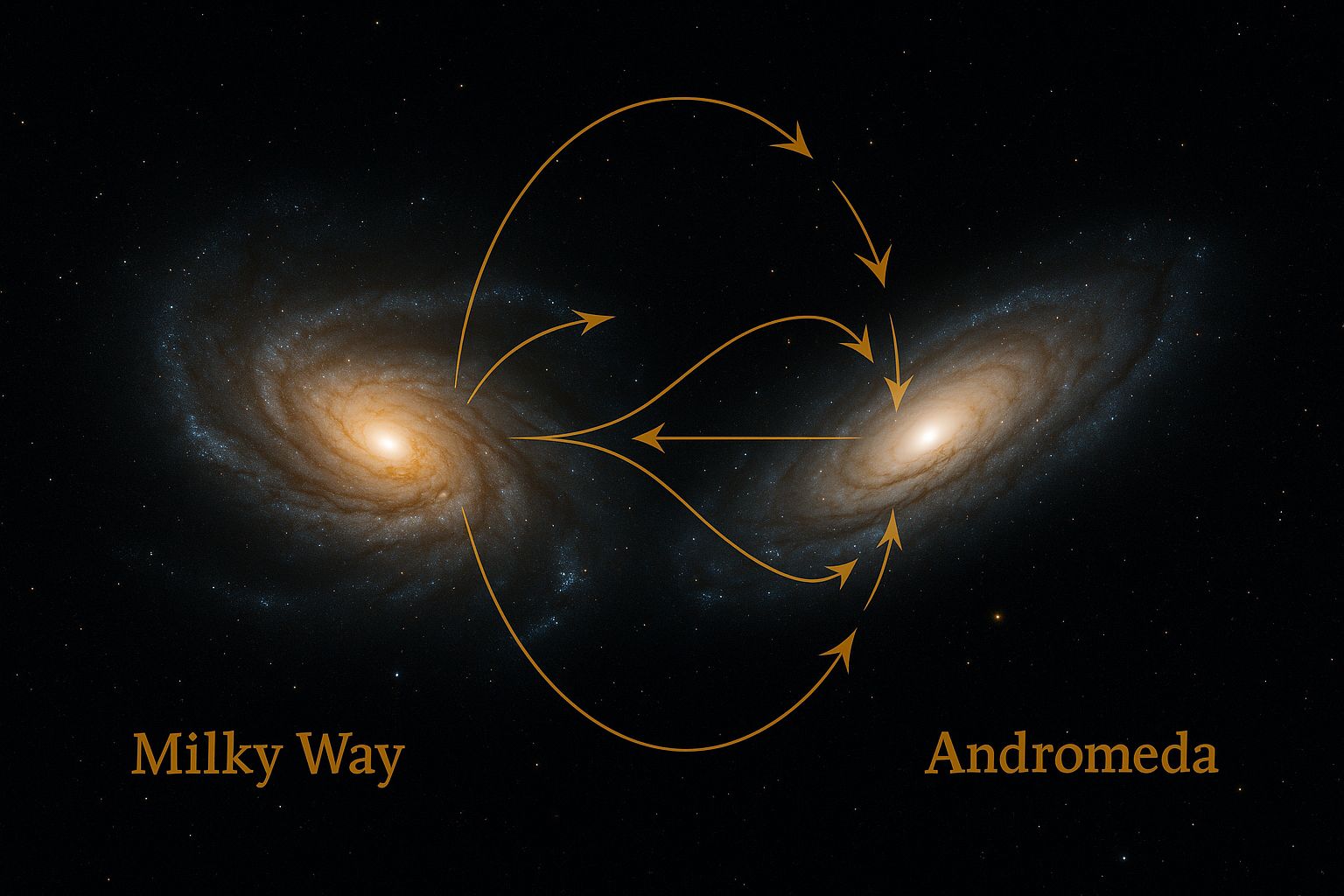
The slowing of expansion is not only a distant phenomenon — it manifests even in our cosmic neighbourhood. The Milky Way and the Andromeda Galaxy (M31) are locked in a slow gravitational embrace, set to collide in about 4.5 billion years. This approach, occurring despite the overall expansion of space, illustrates how local gravity triumphs when the cosmic flow weakens. As the universe breathes out more faintly, its islands of matter begin to drift back together. The future "Milkomeda" galaxy will stand as the living monument of this cosmic contraction.
4. The Return
If the global deceleration continues, the great cosmic web itself may one day halt and reverse. Galaxies would cease to recede, then begin to fall toward one another, culminating in a universal convergence: the Big Crunch — a return to the singular stillness from which all arose.
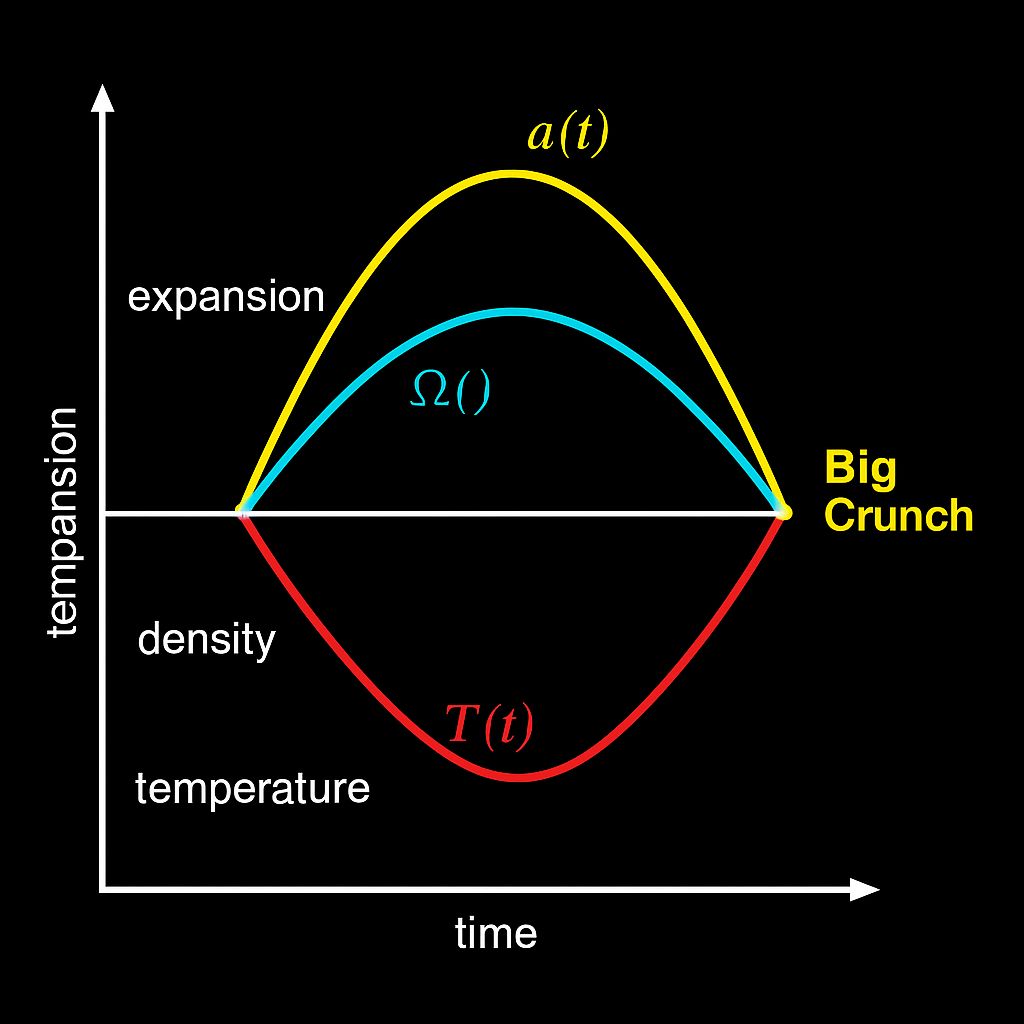
Fig. 1 — The full cosmic cycle: expansion, slowdown, and eventual collapse (Big Crunch) within a PBH-driven cosmological framework.
5. The Philosophical Echo
If the universe slows, perhaps it is not dying but preparing to renew itself. Each collapse could ignite the next Big Bang — a heartbeat of existence and silence, a universe that exhales into infinity and inhales into being once again.
References
- Arbey, A., Auffinger, J., & Sandick, P. (2024). Primordial Black Holes: A Small Review. arXiv:2405.08624
- Villanueva-Domingo, P. et al. (2021). A Brief Review on Primordial Black Holes as Dark Matter. Frontiers in Astronomy and Space Sciences
- Bagui, E., Kuhnel, F., & Visinelli, L. (2025). Primordial black holes and their gravitational-wave signatures. Living Reviews in Relativity
- Filippenko, A. V. et al. (1998). Supernovae, an accelerating universe and the cosmological constant. PNAS 95 (1998)
- Universe's expansion "is now slowing, not speeding up". Phys.org, Nov 2025
- Is the Universe Slowing Down? Stunning New Evidence Says Yes. SciTechDaily, Nov 2025
- The Universe's Expansion May Be Slowing Down, Not Speeding Up. Smithsonian Magazine, Nov 2025
- NASA / ESA Hubble Project (2024). The Milky Way–Andromeda Collision Simulation. nasa.gov
Author: Francisco Gonçalves — Séries Ciência do Cosmos -Fragmentos do Caos
"The universe breathes between creation and silence."