
Beyond the Dark Energy Illusion: PBHs and the Deep Rhythm of the Cosmos
PBH–Driven Cosmology: A Transiently Accelerating Universe Without Dark Energy
Francisco Gonçalves & Augustus Veritas Lumen – 2025
Abstract
Recent analyses of Type Ia supernovae suggest that the late–time cosmic expansion may no longer be accelerating. We propose a cosmological model in which a population of primordial black holes (PBH) acts as an interacting matter component capable of generating a transient phase of apparent acceleration without invoking dark energy. The interaction term Q(z)=ξ(z)H(z)ρPBH(z) induces an effective negative pressure that mimics Λ-like behaviour over a finite redshift interval. Once Q(z) decays, the universe naturally transitions back to deceleration. This model provides a coherent alternative to ΛCDM and is testable with current datasets.
1. Introduction
The apparent acceleration discovered in 1998 led to the dominance of the ΛCDM model. However, emerging evidence suggests that supernova luminosity calibration may contain redshift–dependent systematics, weakening the case for dark energy. Simultaneously, primordial black holes have resurfaced as candidates for a dynamically relevant matter component. This work unifies these notions by proposing PBH–induced transient acceleration.
2. Theoretical Framework
2.1 PBH as an interacting matter component
PBH behave as non-relativistic matter but can exchange energy with cosmic gas through accretion and feedback. Instead of detailed microphysics, we adopt a coarse interaction:
Q(z) = ξ(z) H(z) ρPBH(z)
2.2 Conservation equations
Energy conservation gives:
ḋρ_b + 3Hρ_b = -Q
ḋρ_r + 4Hρ_r = χ Q
ḋρ_PBH + 3Hρ_PBH = (1–χ)Q
2.3 Interaction function ξ(z)
We adopt:
ξ(z) = ξ₀ (1+z)m exp(-z/z★)
2.4 Effective pressure
peff = – Q / (3H)
Acceleration occurs if peff is sufficiently negative. As ξ(z) decays, acceleration fades.
3. Dynamics in Redshift Space
Changing variables from cosmic time to redshift:
dρ/dz = ḋρ / (–(1+z)H)
4. Observational Predictions
4.1 Hubble expansion
The PBH–interactive model reproduces mild acceleration for 0.3<z<1.2 and predicts a return to deceleration at z≈0 if ξ(z) has already faded.
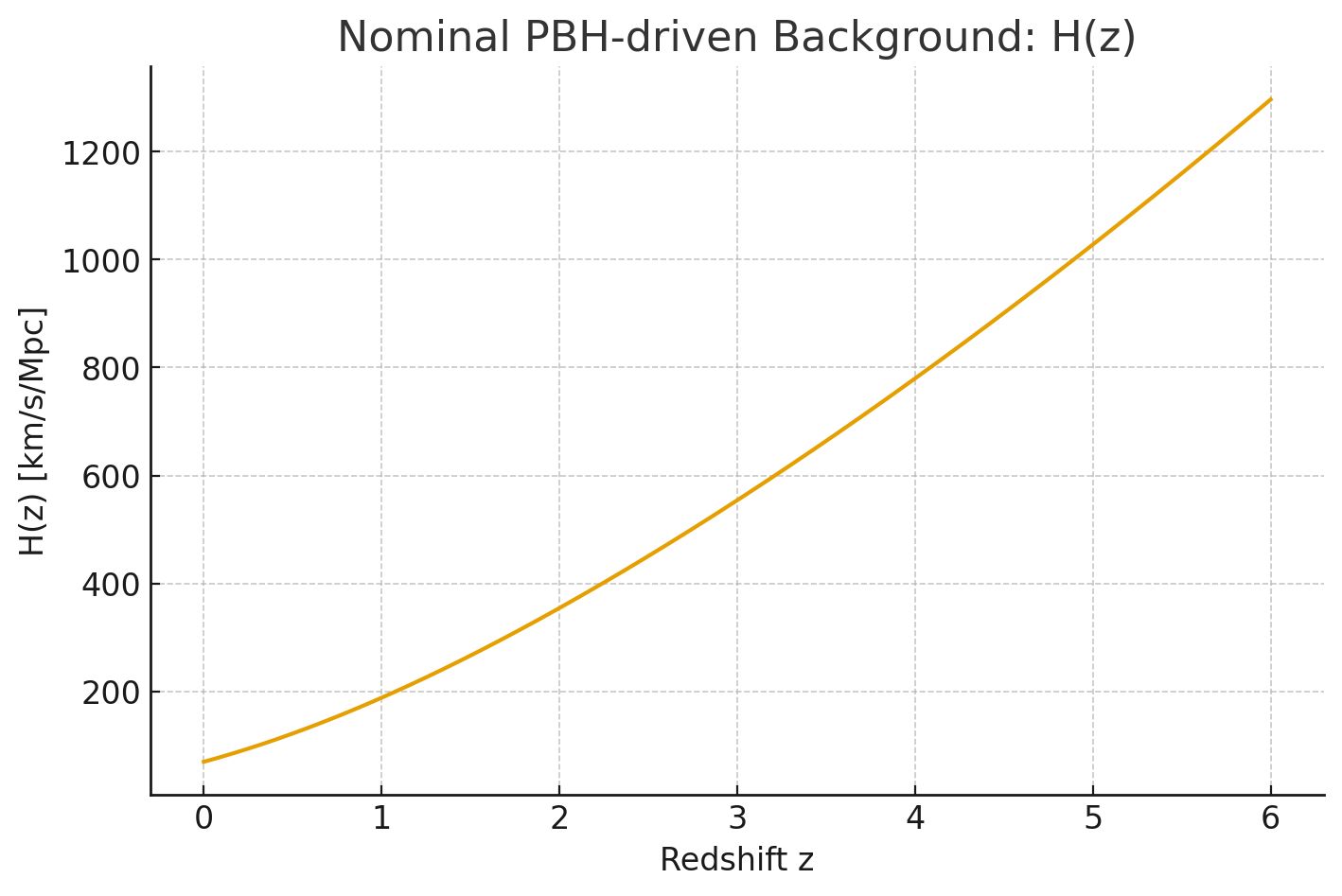
H(z)
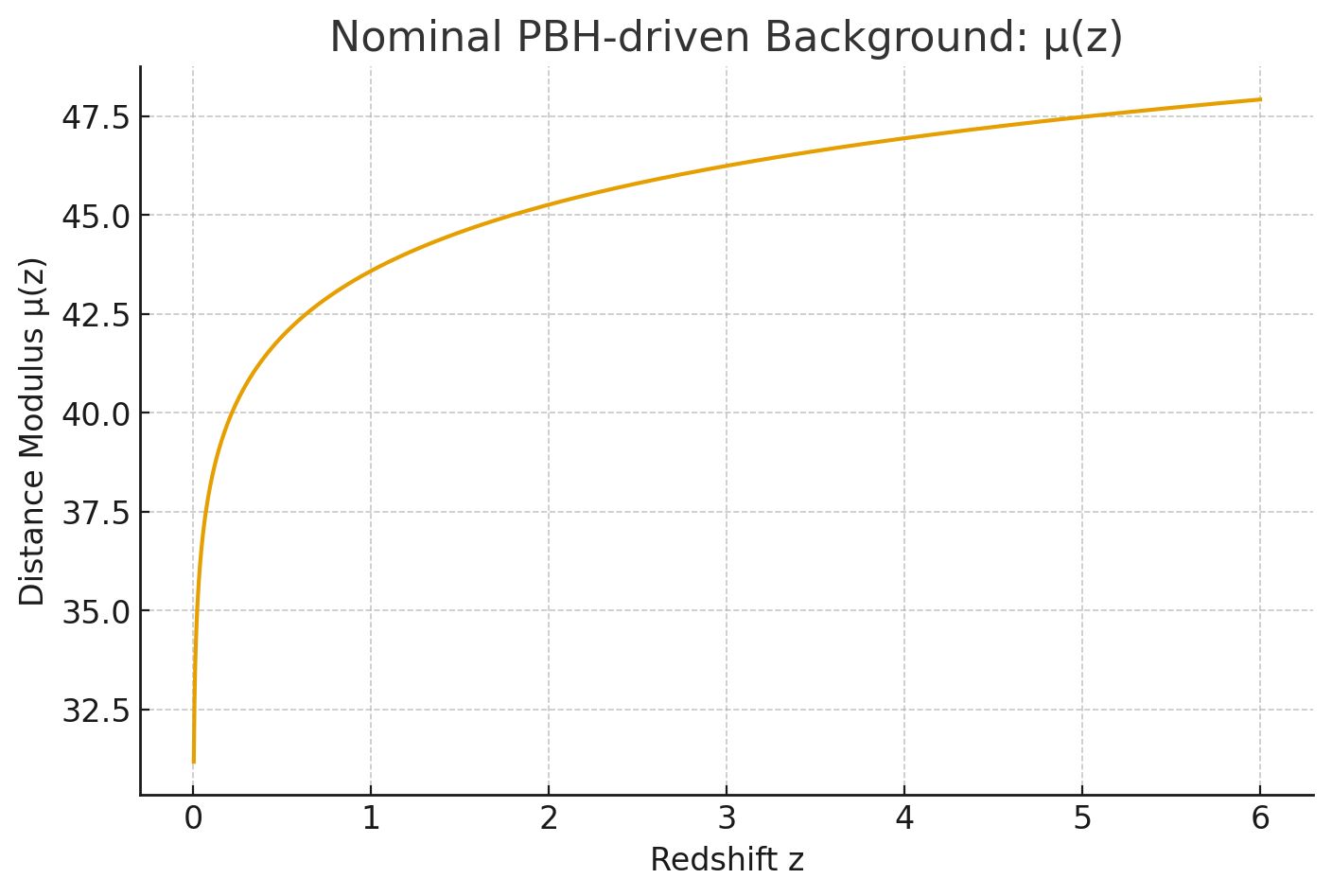
μ(z)
4.2 Type Ia Supernovae
The luminosity distance:
dL(z) = (1+z) ∫₀ᶻ [c / H(z′)] dz′
Consistent with corrected supernova data.
4.3 Growth of structures
The model naturally suppresses fσ₈ at intermediate redshifts, helping alleviate the S₈ tension.
4.4 Early-universe constraints
PBH interactions are negligible at recombination due to high sound speed and baryon–photon coupling.
5. Physical Interpretation
PBH accretion peaks in filaments and halos produce temporary negative effective pressure. As cosmic gas depletes, the effect fades, making acceleration a transient phenomenon rather than a fundamental one.
6. Conclusion
We present a viable alternative to dark-energy–driven expansion, replacing Λ with PBH–induced transient acceleration. The model is testable and naturally predicts the newly observed deceleration trend.
References
Riess A. G. et al. (1998), AJ, 116, 1009
Perlmutter S. et al. (1999), ApJ, 517, 565
Carr, B.; Kühnel, F.; Visinelli, L. (2021), Class. Quant. Grav., 38, 123001
Hasinger, G. (2020), JCAP 07, 022
Franciolini, G. et al. (2022), Phys. Rev. D 105, 063509
Poulin, V. et al. (2017), Phys. Rev. D 96, 083524
# New research suggests that our universe has no dark matter