
The End of Darkness: Rethinking the Universe Without Dark Matter
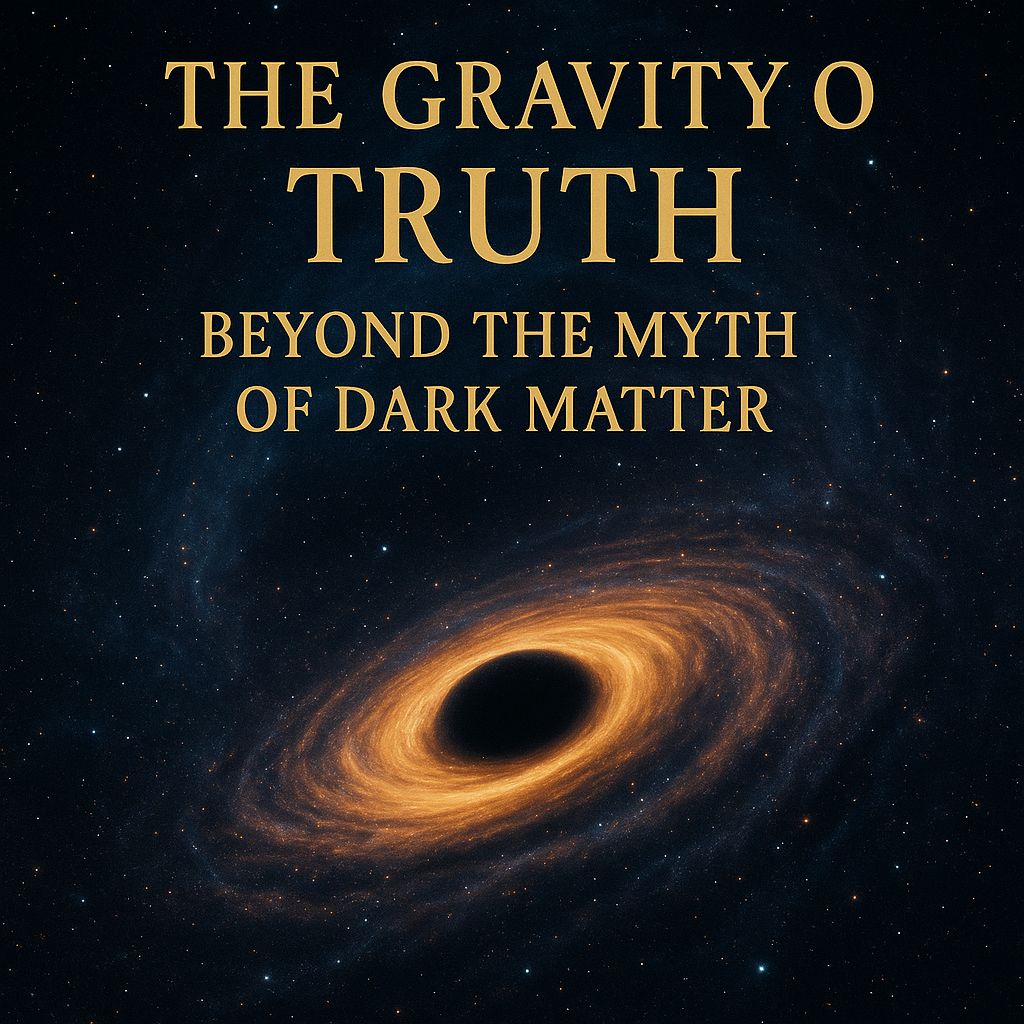
The Gravity of Truth
Beyond the Myth of Dark Matter
By Francisco Gonçalves — Fragmentos do Caos
For decades, cosmology has claimed that two invisible entities — dark matter and dark energy — rule 95% of the universe. Yet after billions spent and countless detectors built, not a single particle has been found. Perhaps the problem is not what we cannot see — but what we insist on believing.
1. The Empire of Shadows
When science forgets humility, it creates new gods — elegant equations to fill the void of understanding. Dark matter was born from such a need: an invisible scaffolding invented so that galaxies would obey Newton and Einstein. Later, dark energy appeared as the cosmic pusher, the ghost that accelerates expansion.
Half a century of searching has led nowhere. The telescopes saw nothing, the underground chambers heard nothing. The universe, once again, remained silent.
2. The New Heresy
It takes courage to question a cathedral built on mathematics. Rajendra Gupta, from the University of Ottawa, now does just that. In his model, neither dark matter nor dark energy is needed. The fundamental forces of the universe — gravity among them — slowly weaken as the cosmos ages. The illusion of hidden forces may be nothing more than the universe breathing in slow motion.
According to Gupta, the cosmos is not expanding into chaos, but evolving through its own fading strength. What seems like a mysterious push may simply be the natural rhythm of spacetime adjusting to its own fatigue.
3. The Black Hole Paradigm
Long before Gupta's publication, Francisco Gonçalves proposed a similar insight: that the true engines of the universe are not invisible particles, but black holes — real, measurable, relentless. They are the gravitational hearts of galaxies, the silent architects of cosmic structure. What theoretical physics calls "dark matter" might, in truth, be the aggregated effect of these massive, observable objects shaping spacetime on every scale.
His vision restores the cosmos to the realm of the tangible. No more metaphysical shadows — only the gravity we can see, measure, and feel. Where others invent dark halos, Gonçalves sees order emerging from curvature; where others multiply equations, he listens to the eloquence of reality.
4. The Coming Revolution
Every era of science begins with faith and ends with revision. The geocentric model, the ether, the static universe — all beautiful illusions that collapsed under the weight of truth. Dark matter may soon join them.
Equations are not the universe; they are its mirrors. And when the mirror becomes more sacred than the reflection, illusion triumphs over observation. Perhaps it is time to return to simplicity — to the gravity that truly moves the stars.
5. A New Map of Creation
The next cosmological age will not be built on invisible matter, but on real curvature. A map where black holes, neutron stars, and gravitational waves replace the conjectural fog of the unseen. A universe where expansion is not acceleration, but redistribution — a slow, graceful choreography of energy and geometry.
Maybe, as Francisco proposes, the cosmos is not doomed to fade into heat death, but destined for a gravitational renaissance — a vast reorganization, where what once fell into darkness returns to the luminous symmetry of origin.
"We have long searched in the dark for what has always shone in the light: gravity is the true code of the cosmos, the pulse that bends space, the melody that orchestrates existence. When we stop inventing ghosts to explain the universe, we may finally begin to understand it."
—
Francisco Gonçalves, Fragmentos do Caos
© 2025 Francisco Gonçalves — Fragmentos do Caos
Image credits for OpenAI (c)